Brembo 2-piece disc, brake fluid, and pad install on GMG Racing’s 991 GT3

GMG Racing 991 GT3 – Brembo Performance Install & Review

GMG Racing, an Official Brembo dealer, is one of the premier high performance and professional racing shops in Southern California who specialize in Porsche track preparation. GMG Racing’s background in professional racing campaigning multi-car efforts in the Pirelli World Challenge series with both Porsche and Audi FIA GT3 platforms. Using this extensive racing experience accumulated over the years, GMG Racing also offers up the same upgrades supplied by their technical partners that they trust on the racetrack.

James Sofronas, owner driver of GMG Racing, also owns a personal 991 GT3 shop car to showcase GMG’s capabilities on and off the track. One such way is by holding track day and driver training specifically for 991 GT3 owners at The Thermal Club raceway which is very demanding on brakes and tires.

GMG Racing 991 GT3 Trackday. Photo Credit : GMG Racing

GMG Racing 991 GT3 Trackday. Photo Credit : GMG Racing

One of the first major upgrades done to the GMG Racing’s 991 “WC-GT3” was improve the braking reliability, longevity, and performance under track use. GMG Racing swapped out the Porsche OE discs, pads and fluid on the 991 GT3 with Brembo 2-piece discs, Race Technologies pads, and Brembo Racing HTC64T fluid.

GMG Racing 991

GMG Racing 991 “WC-GT3”

INGREDIENTS REQUIRED:

  • Porsche 991 GT3
  • GMG Racing
  • Brembo 2-piece front disc assemblies.
  • Brembo 2-piece rear disc assemblies
  • Your choice of front and rear pads although Race Technologies TS20’s were used.
  • 6 bottles of Brembo HTC64T Racing brake fluid.
  • Tarett Engineering brake caliper studs (*optional, supplied by GMG Racing)
GMG Racing 991 GT3.

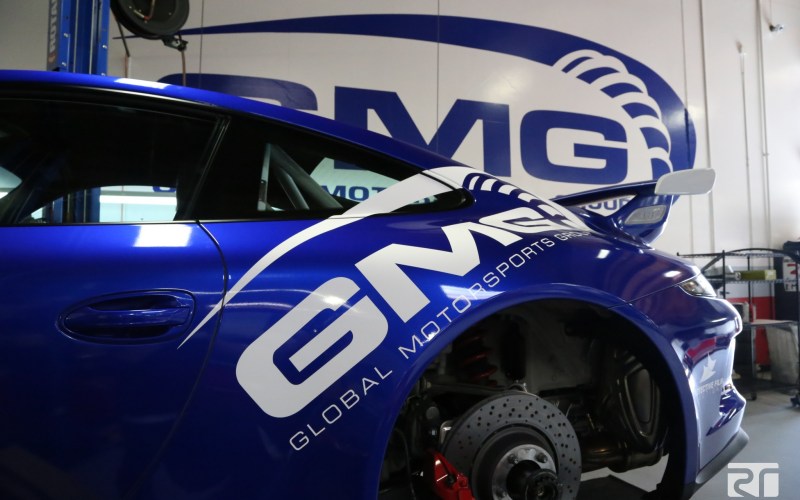
GMG Racing 991 GT3 in stock form.

BRAKE DISC COMPARISON

While the 991 GT3 has very sophisticated brakes for an OE brake package, there is always more that can be done with certain components to improve overall longevity and performance. The OE Porsche brake discs, pads and fluid are all engineered with comfort, serviceability and cost effectiveness in mind.

Brembo OE co-cast discs

Brembo OE co-cast discs

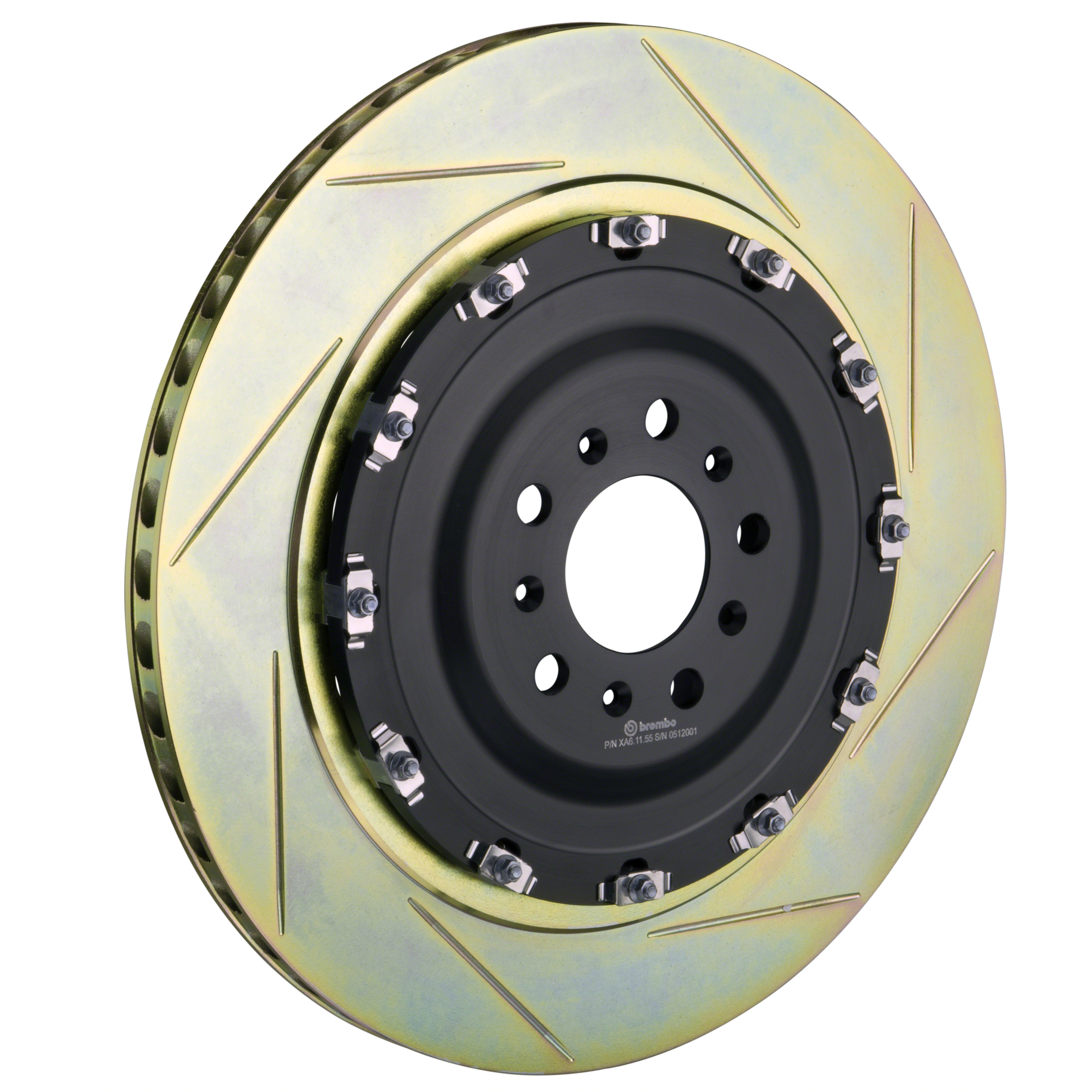
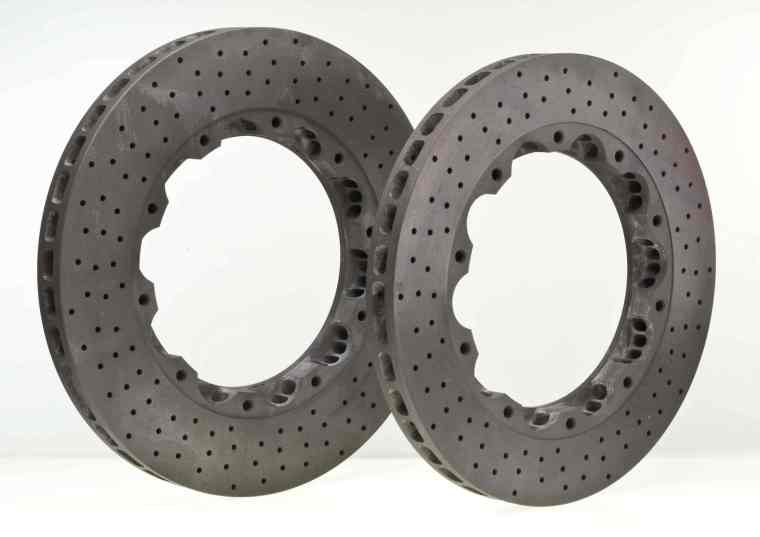
As the braking system’s primary function is to dissipate heat, Brembo uses purpose-designed discs in order to increase the fade resistance and thermal capacity of the system. These discs are directionally ventilated for enhanced cooling and slotted for better performance and continuously refreshing the pad surface. Brembo 2-piece discs are made up of a proprietary advanced cast-iron alloy which offers an exceptional coefficient of friction and resistance to thermal shock and fatigue.

The same Brembo Racing discs trusted every weekend in professional motorsports are also utilized in the Brembo Performance program (GT, GT-R & club race systems).

The OE 991 GT3 co-cast Brembo discs are sized 380 x 34 mm in the front and weigh 24 lbs, and 380 x 30 mm in the rear weighing at 23.4 lbs. The Brembo Racing Heavy Duty “HD” type V front disc assemblies are 24.5 lbs, and the rear Type III assemblies are 22 lbs. The 991 Turbo discs are substantially heavier than the GT3 discs as the Turbo models are harder on front brakes than the GT3 models. Brembo 2-piece disc assemblies on a 991 GT3 or Turbo will offer a net gain in weight savings.

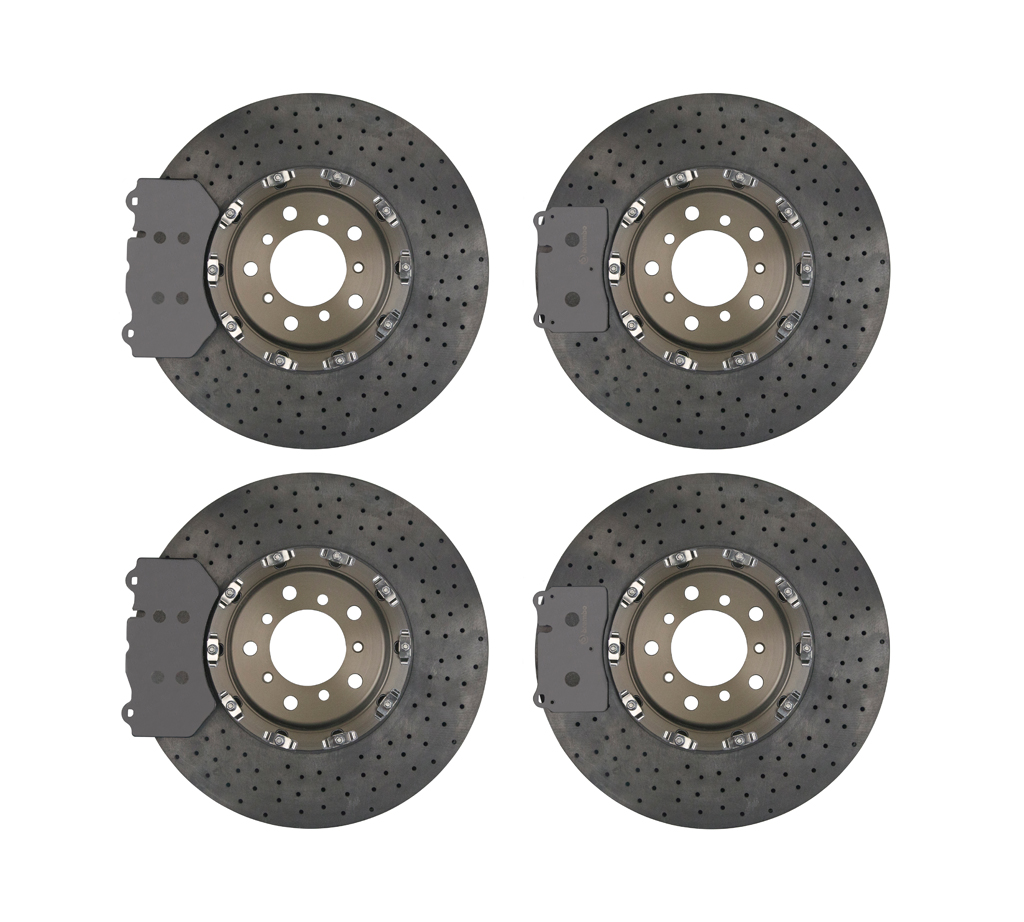
Brembo Porsche OE discs vs Brembo Performance 2-piece disc assemblies

Brembo Porsche OE discs vs Brembo Performance 2-piece disc assemblies

There are many advantages to replacing the OE discs on a Porsche GT3 or Turbo, some of them are:

  • OEM Integration: Brembo upgrades are designed to work seamlessly with the OE Master, ABS and existing brake systems (Example: Integration with the rear parking brake)
  • Weight Savings: Reducing overall un-sprung weight helps improve vehicle dynamics such as handling, braking, and acceleration.
  • Durability: The Brembo discs for these Porsche disc assemblies come from the Brembo Racing program. These discs feature proprietary metallurgy which is resistant to fatigue, cracking, and are engineered for maximum longevity on the street or track.
  • Different Slot Types: Extensively used in professional motorsports, Brembo type III and type V disc face types can be used to tune or adjust the brakes’ technical characteristics to the chassis or driver.
  • Range: Brembo offers lightweight and heavy duty “HD” disc options to suit the needs of the driver, car model (Turbo or GT3) /setup and environment.
  • Replacements: Brembo replacement rings are comparably priced to OE, and when the Brembo discs are worn, only the outer disc ring and hardware needs to be replaced.
  • Drivability: Brembo 2-piece discs maintain the drivability of the OE brakes by using anti-rattle hardware. Brembo’s specific anti-rattle disc hardware utilizes a spring fastener in order to slightly preload the assembly which eliminates the noise (clattering) generally associated with floating discs.

Brembo OE Porsche disc vs Brembo 380 mm 72 vane racing disc

Brembo McLaren spring

Brembo McLaren spring

NOTE: Brembo’s specific anti-rattle hardware which is commonly used in high performance brake disc assemblies was actually developed in the 1990s. This innovation was initially engineered exclusively for the McLaren F1 supercar which is why the hardware is often nicknamed the “McLaren” spring.

 BRAKE DISC INSTALLATION

GMG technicians Ruben and Sergei (who drives a 997 Turbo himself) used their extensive Porsche know how to install the Brembo 2 piece disc assemblies on the GMG 991 GT3 shop car.

GMG Technicians working on GMG 991 GT3

GMG Technicians working on GMG 991 GT3

 FRONT DISC ASSEMBLIES

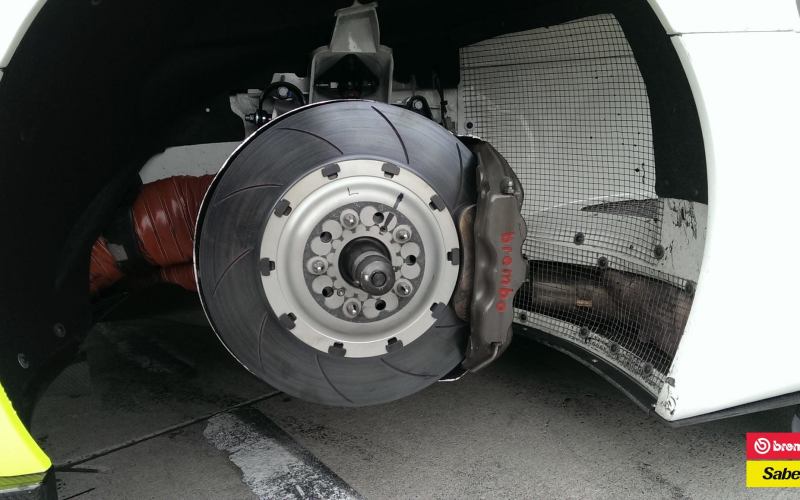
The OE front discs were the first to be installed. The Brembo performance 2-piece discs and Race Technologies pads are a direct replacement to the OE units. GMG made sure to push the pistons all the way back in to ensure proper stack width (2 pads and brake rotor total width). The Porsche center lock “lug” was then removed and the Brembo 2-piece disc assembly and pads were then installed. Once the Brembo performance disc assemblies were fitted, the OE Caliper was re-installed using brand new caliper studs. The entire process was done on the front right disc, and then the front left disc.

Porsche 991 GT3 OE front brakes

Porsche 991 GT3 OE front brakes

Porsche centerlock unit

Porsche centerlock unit

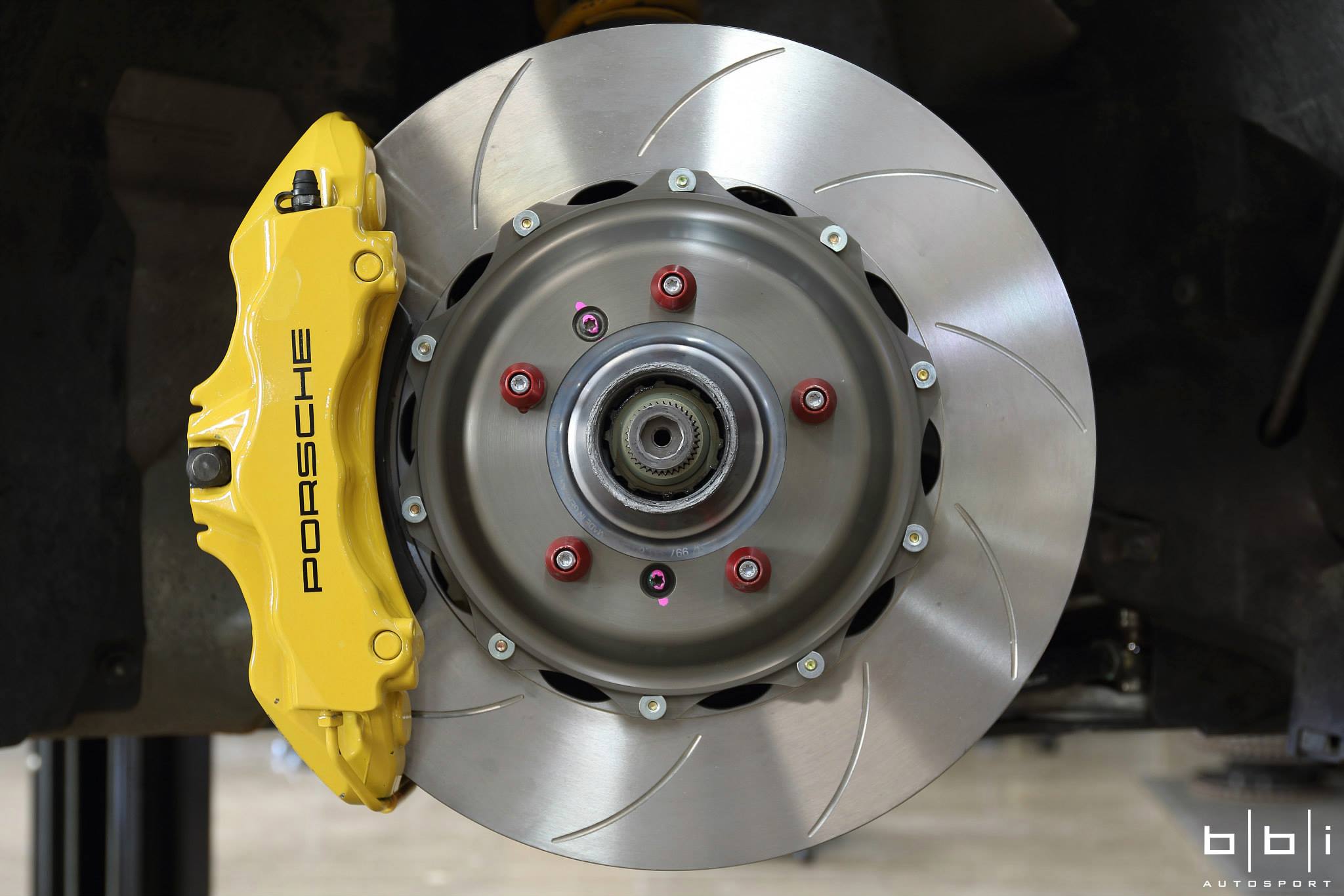
Brembo Porsche OE front disc vs Brembo 380 mm racing disc and pads.

Brembo Porsche OE front disc vs Brembo 380 mm racing disc and pads.

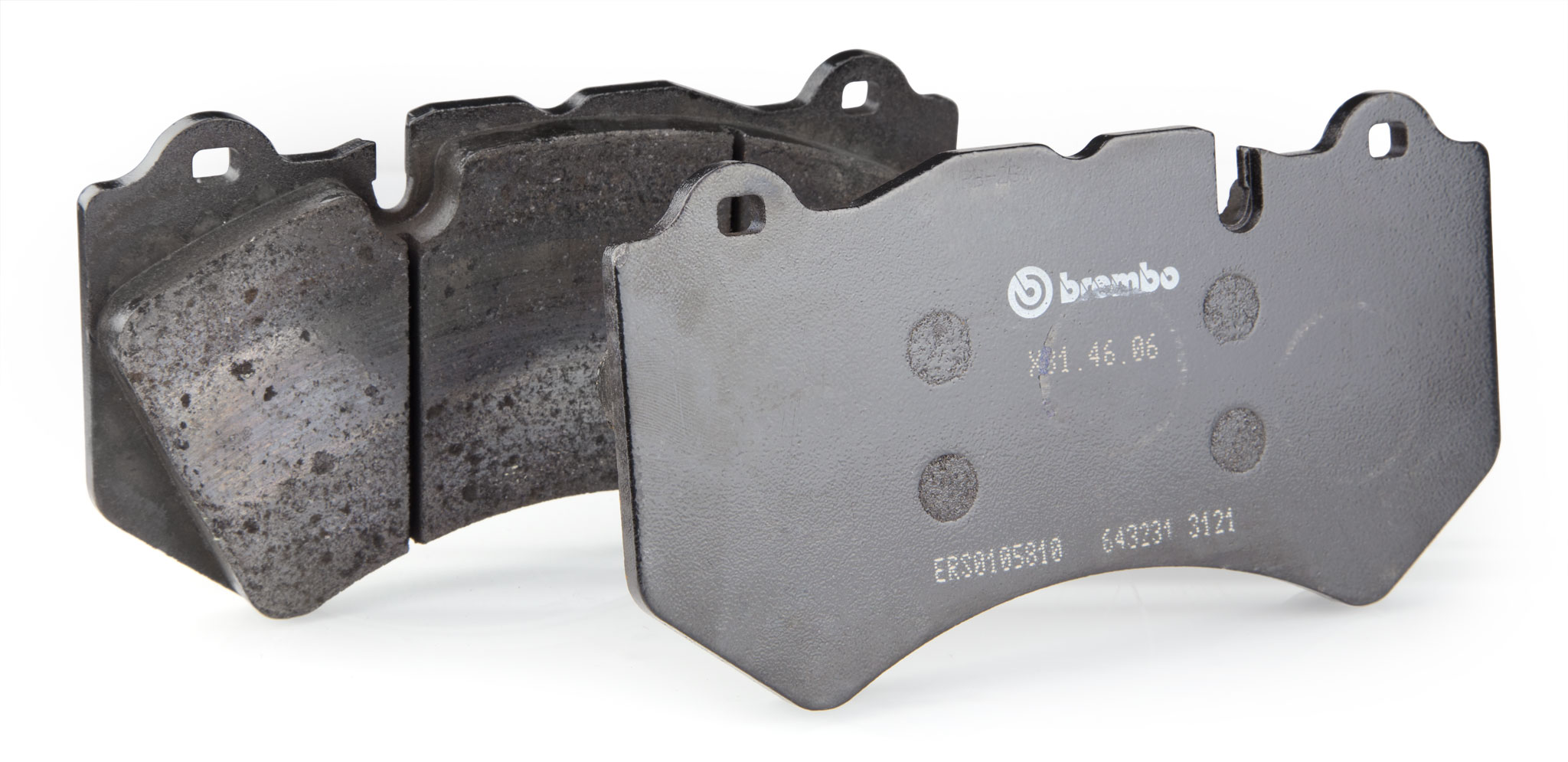
The Race Technologies TS20 compound was specified as the baseline pad since the car will be street driven and used on the track. The TS20 offers low noise, dust and good pedal feel. It is also an excellent dual purpose compound for street and light track use.

Brembo 2-piece disc assembly fitted
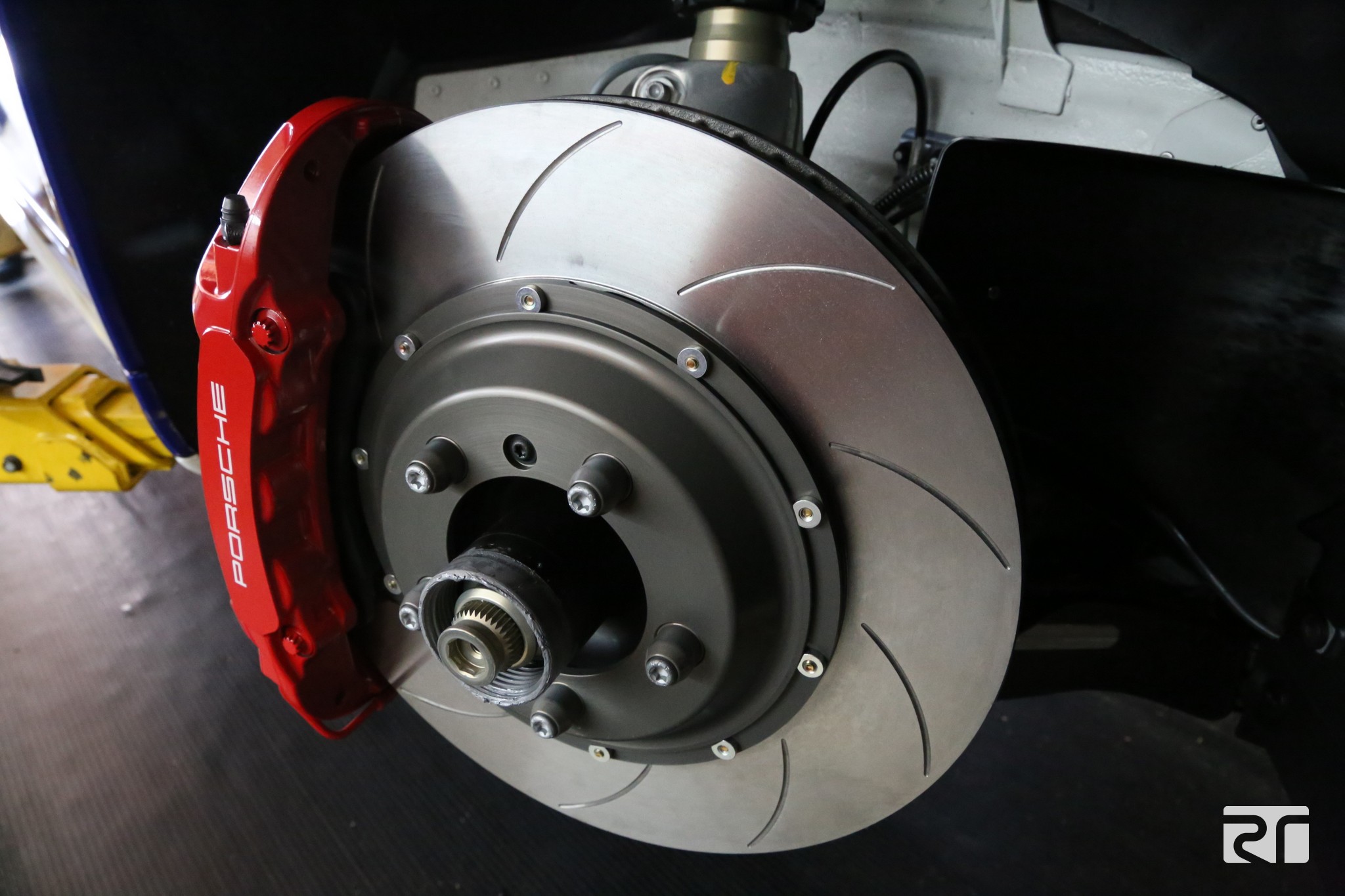
Brembo 2-piece disc assembly fitted

Brembo 2-piece disc assembly installed

Brembo 2-piece disc assembly installed

Since the GMG Shop car is also their test car, the car will see extended track time on many southern California circuits. A Brembo Type V 380 x 34 mm front disc was specified for the lowest disc and pad wear under heavy track conditions. An optional Race Technologies endurance compound was also supplied for dedicated track use.

  • Brembo Type V (endurance face type): motorsport developed face type with marginally less initial response compared to the type III face type. The Brembo Racing type V face type was also designed to have lower pad and disc wear for certain long distance endurance races (mostly 10, 12 and 24 hour races).

REAR DISC ASSEMBLIES

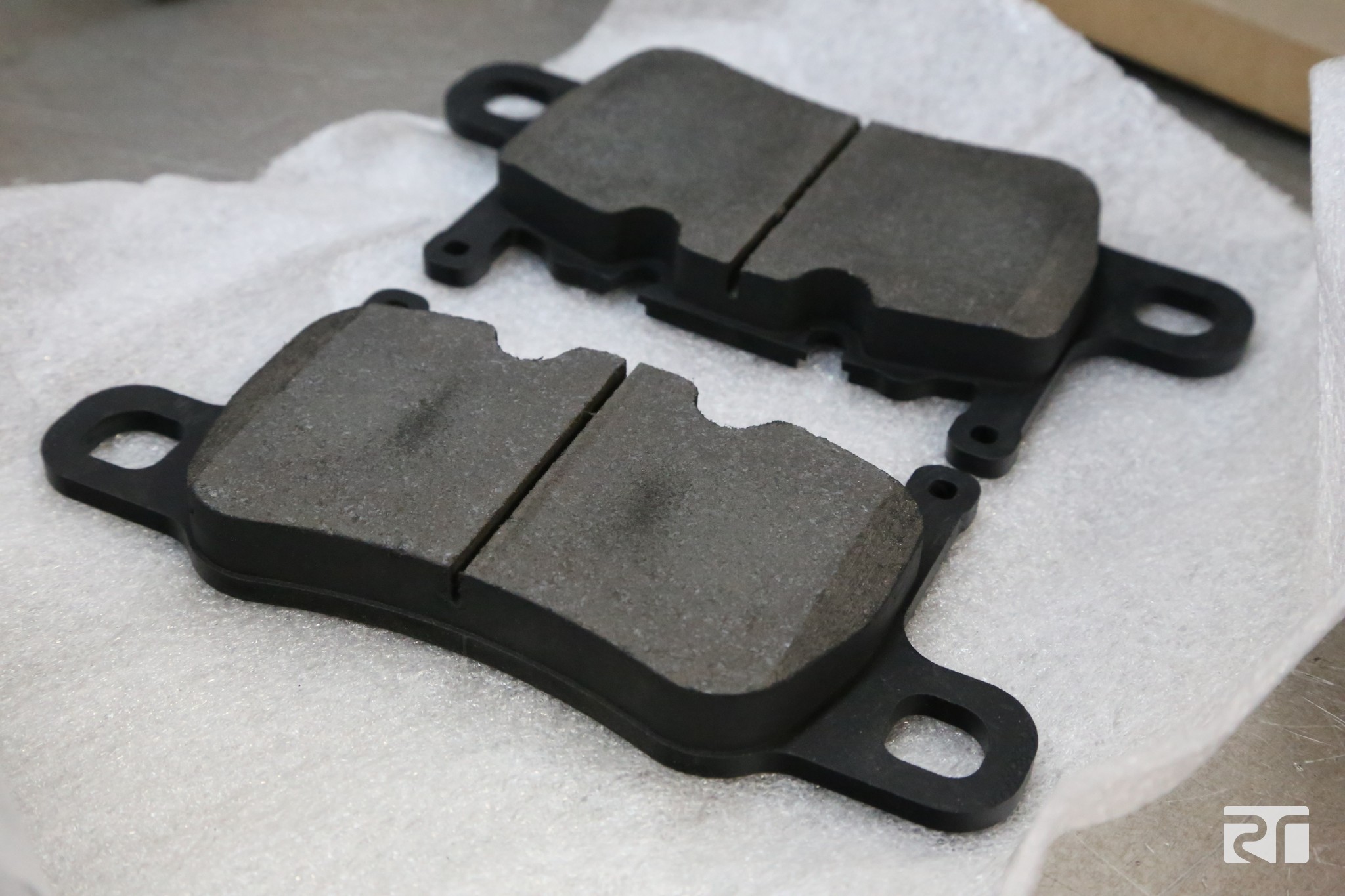
Once the front disc assemblies were installed, GMG then turned their attention to the rear discs and pads. The exact same installation procedure was followed for the rear disc assemblies as well. The rear right corner was installed first, and then the rear left corner was installed. GMG installed new caliper studs on the rear as well when re-installing the OE Porsche calipers. Race Technologies TS20 compound pads were used for the rears as the baseline pad.
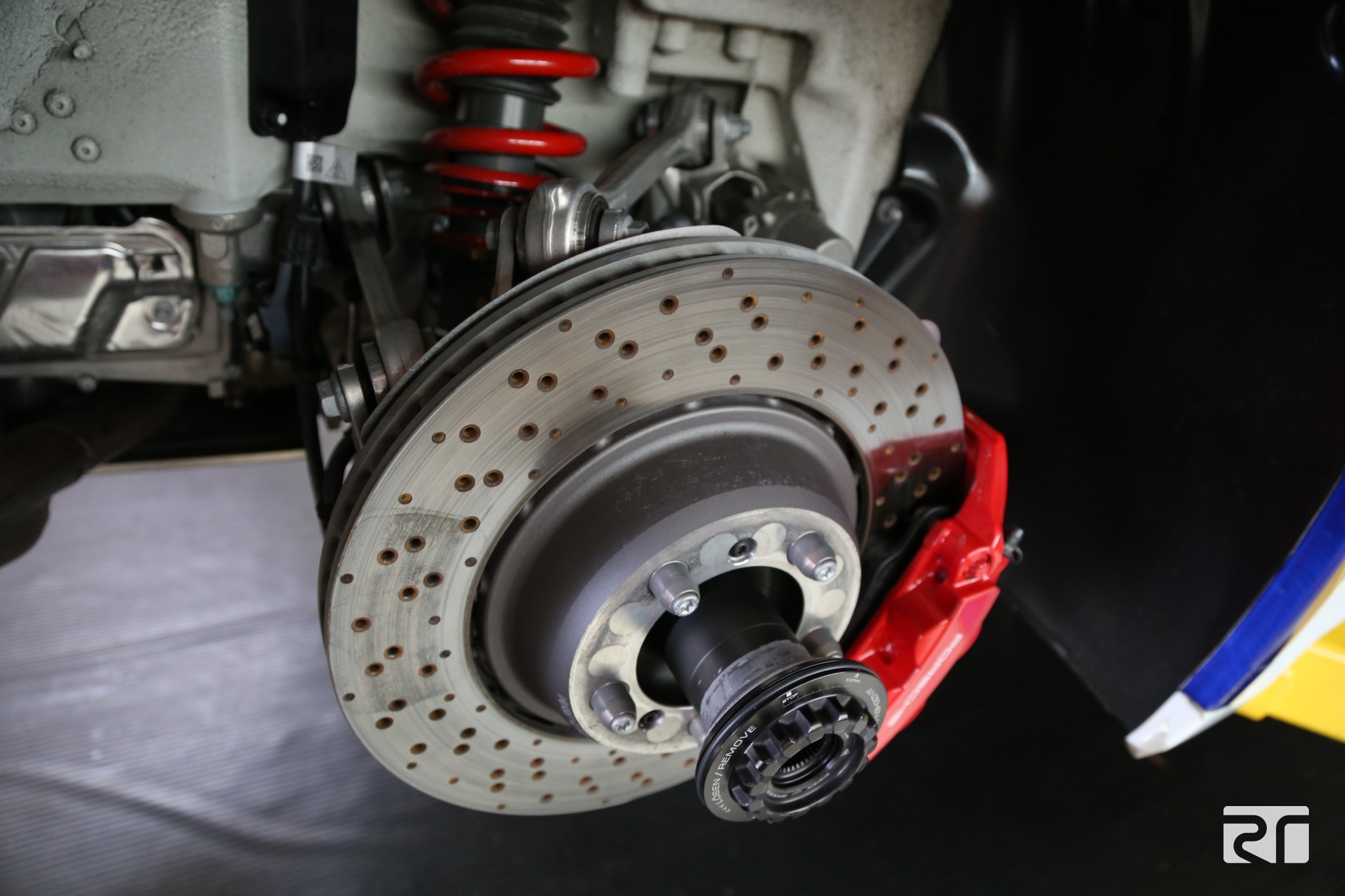
Porsche 991 GT3 rear brakes
Porsche 991 GT3 rear brakes

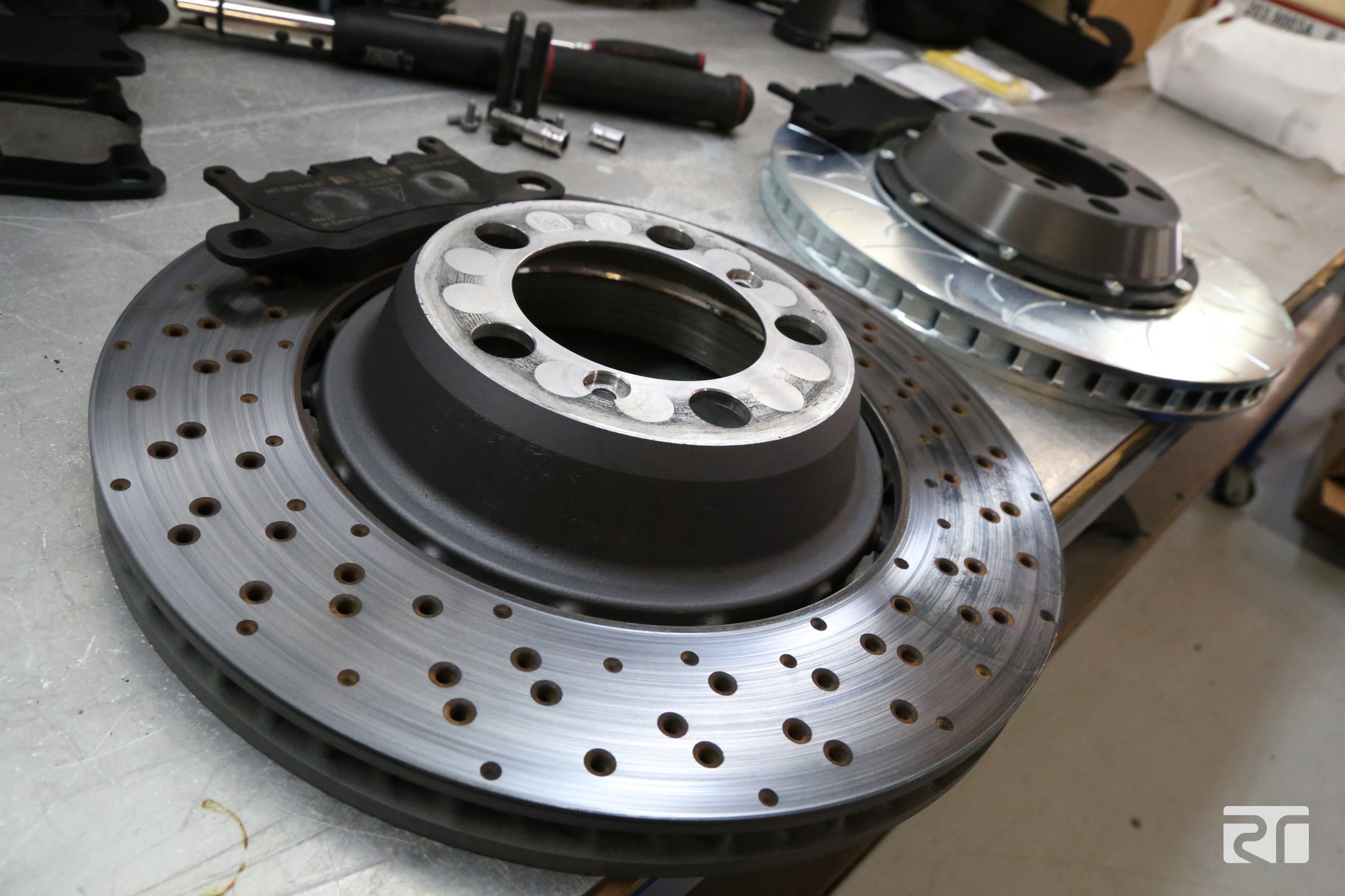
Porsche OE 991 GT3 rear discs vs Brembo performance Type III discs

Porsche OE 991 GT3 rear discs vs Brembo performance Type III discs

Tarrett Engineering Caliper studs used by GMG Racing.
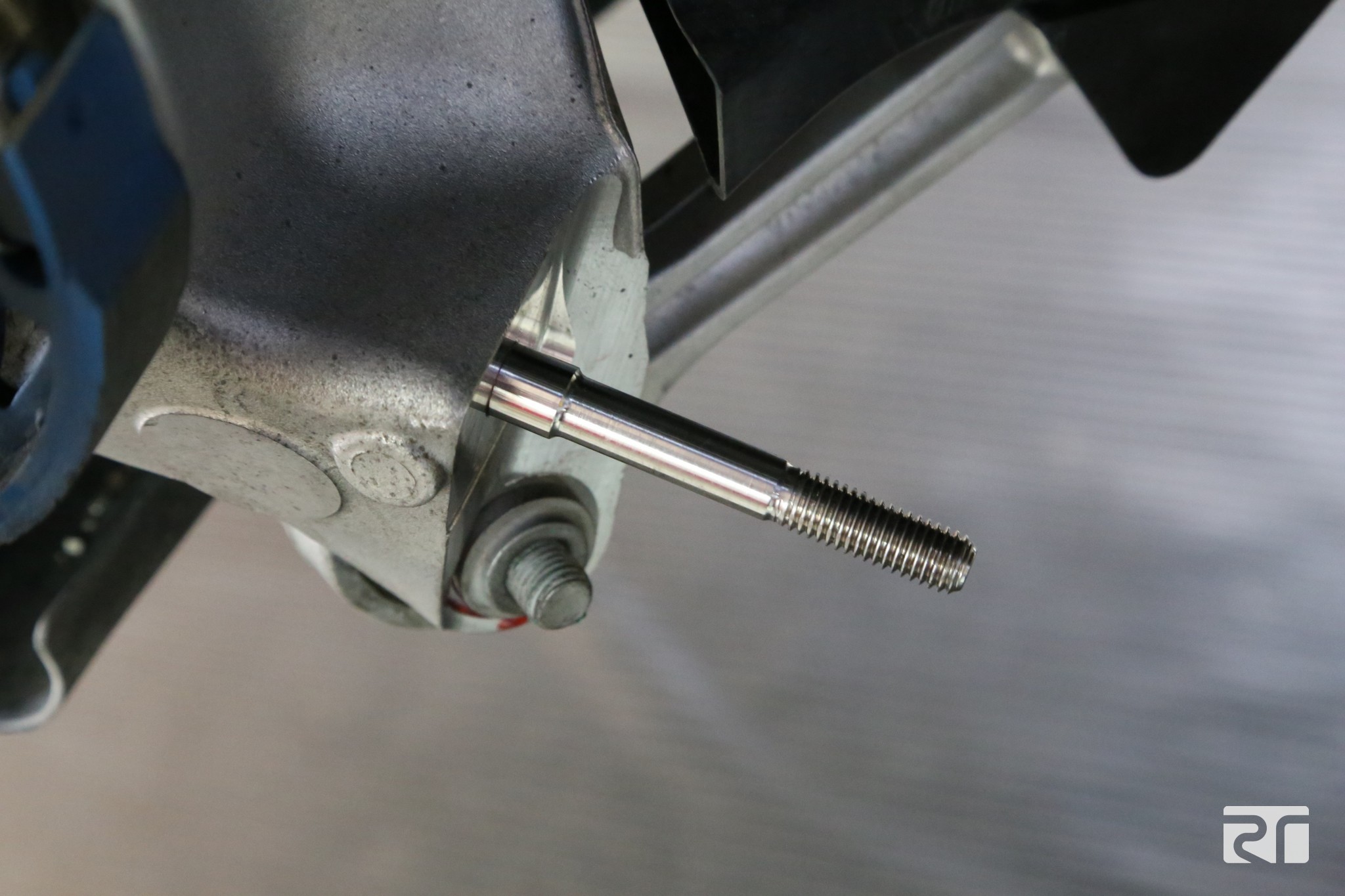
Tarett Engineering Caliper studs used by GMG Racing.

GMG installed Tarett Engineering caliper studs.
GMG installed Tarett Engineering caliper studs.

RT TS20 rear pads

RT TS20 rear pads

The Brembo Type III 380 x 30 mm rear brake disc was specified for optimum balance and brake release under heavy track conditions. This is because the 991 GT3 shifts its’ brake balance towards the rear under braking. The smooth release characteristics of the Brembo Type III face type can help a driver avoid rear tire in stop lock up while still maintaining optimum braking performance.

  • Brembo Type III (aggressive face type): motorsport developed face type with an emphasis on high initial response while maintaining a smooth pedal release.
Brembo 380 x 30 Type III rear disc fitted.

Brembo 380 x 30 Type III rear disc fitted.

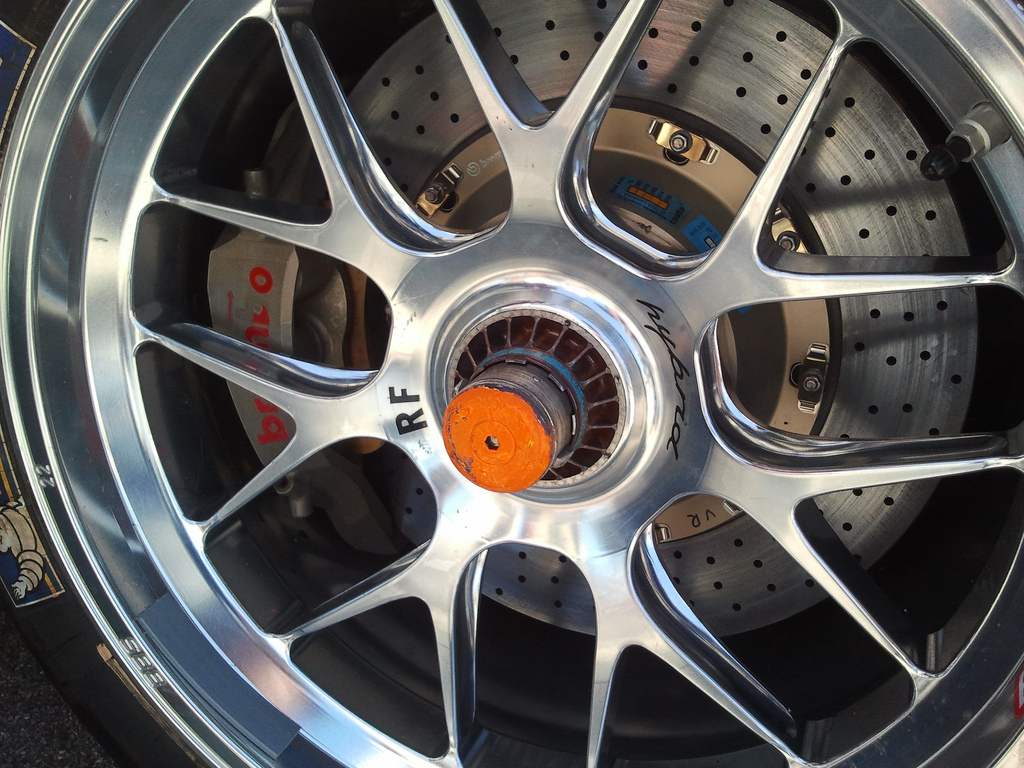
Brembo Performance Type III rear discs installed on GMG 991 GT3

Brembo Performance Type III rear discs installed on GMG 991 GT3

As mentioned earlier in this article, the Brembo 2-piece disc assemblies are compatible with the Porsche factory parking brake. One does not have to compromise and lose the parking brake functionality when installing the Brembo disc assemblies.

BRAKE FLUID AND BLEED

Upgrading brake fluid for spirited, track or racing use is easily one of the most overlooked things when thinking of upgrading any component or part of the brake system. Brembo’s HTC64T brake fluid is the top fluid used in the top professional racing categories around the world (Examples: F1, FIA GT, LMP1). This is because the Brembo fluid offers low compressibility, good after boil recovery, and high boiling points.

  • Brembo HTC64T Typical Applications: Open Wheel*, Stock Car, Rally, Endurance & Sprint GT**, Track Day.

*Brembo HTC64T is one of a very few select fluids being actively used by F1 teams.

**Brembo HTC64T and LCF600 Plus are both racing brake fluids which are actively used and homologated for FIA GT3 & GTE based sports-car racing.

  • Independently proven low Compressibility at severe temperatures.
  • Dry Boiling Point: 335 C (635 F)
  • Racing Use Only
Brembo HTC64T

Brembo HTC64T (used in F1, FIA, GT, LMP1)

Brake fluid performs a very critical function as it is the “life blood” of the brake system, as it is the foundation to hydraulically transfer brake pedal effort to the brake caliper’s pistons. Brake fluid also performs a vital function of lubricating caliper piston seals brake fluid performance (or the lack of) can directly affect brake pedal feel, pressure and consistency through the operating temperature range. It is also one the most cost effective ways to improve brake pedal consistency (avoiding spongy pedal) under high temperature use.

Once the Brembo performance 2-piece disc assemblies and RT pads were installed on all four corners, the OEM brake fluid was flushed and bled with Brembo Racing HTC64T brake fluid. As the fluid was being bled on each corner, GMG made sure to keep an ample amount of new fluid filled in the master cylinder reservoir to ensure that air did not enter into the hydraulic system.
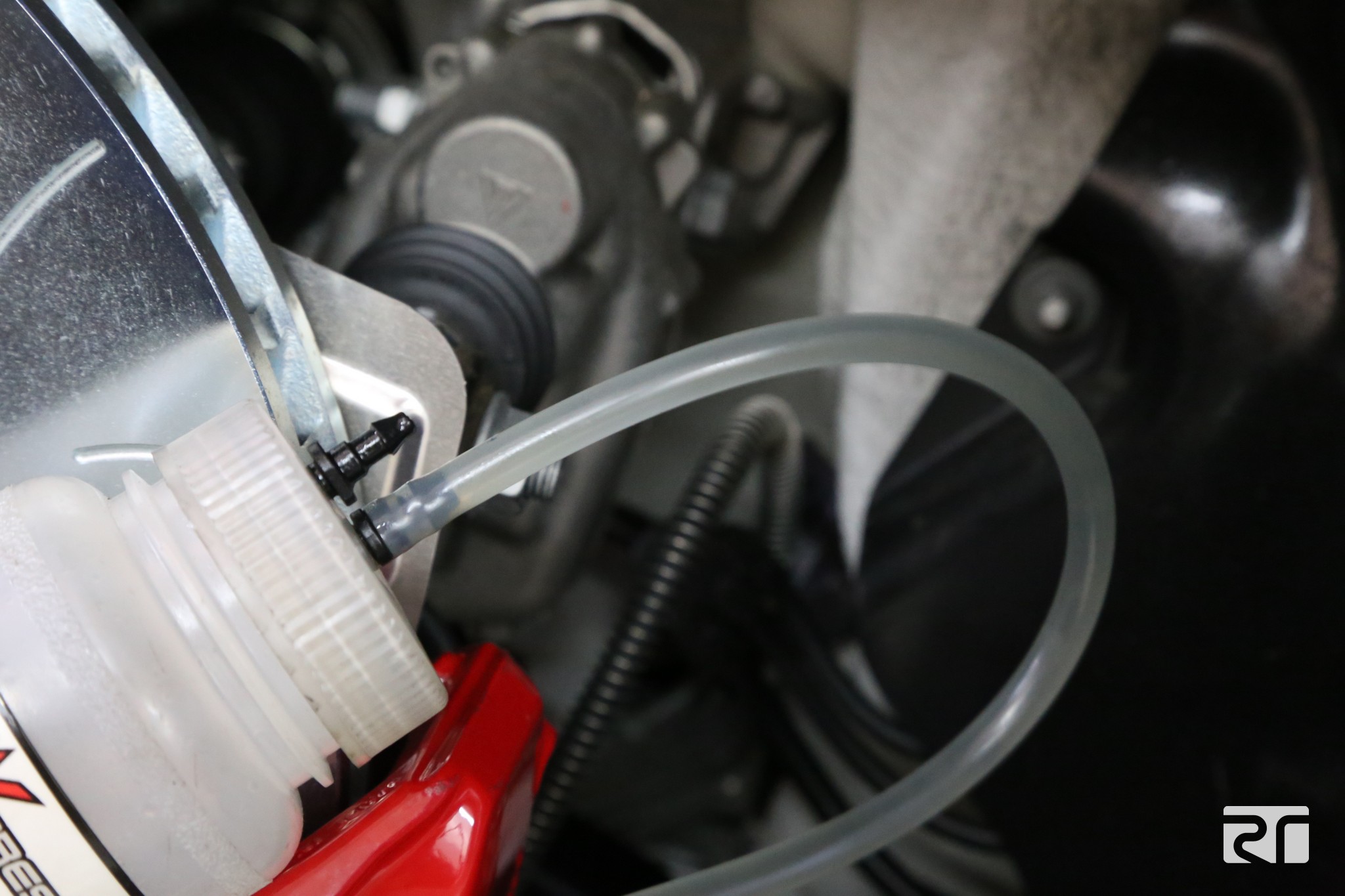
Brembo fluid bleed

Brembo fluid bleed

Brembo HTC64 being poured in

Brembo HTC64 being poured in

ON TRACK IMPRESSIONS

To evaluate the results of the new Brembo discs, fluid bleed, and RT pads, the GMG Team took the 991 GT3 shop car to Thermal Club.

Driver (James Sofronas) and GMG Team comments: Testing out a new setup @thethermalclub today! @jamessofronas had the GMG 991 GT3 out and with the new Brembo Brake pad and Rotor setup says that the car is even more amazing! A predictable pedal feel without activating the ABS too early. A must have for any car that is going to see some track time! Combined with Pirelli Trofeo R tires it is just a winning combo!

Thermal Club Track layout. Image: Thermal Club

Thermal Club Track layout. Image: Thermal Club

Thermal Club located in Palm Springs, California often has very high ambient temperatures which can be demanding on the car, tires, and brakes. The effectiveness of brake cooling is only as good as the temperature of the air flowing thru the brake ducts (if the ambient air is hotter, the brakes will not cool down as much). The track layout and surface can be very similar to some of the European GT tracks, featuring many high speed to low speed braking zones, and a high level of mechanical grip (the more grip you have, the harder you can brake). GMG Racing has setup their shop GT3 understanding the demands of the various tracks around Southern California, and the Porsche 991 GT3, for optimal results.

GMG Racing 991 GT3 and R8 LMS Ultra at Thermal

GMG Racing 991 GT3 and R8 LMS Ultra at Thermal

Modern sports cars have very sophisticated OE ABS systems and engaging the ABS under braking can lead to poor threshold braking, lack of pedal feel, and potentially result in a slower lap time. Having a high overall level of braking confidence and control, usually allows the driver to spend less time on the brake pedal. If the brakes offer enough performance and control for the driver to stay out of ABS engagement (depending on their driving style and car setup), the result is usually a faster lap time on track.
Brembo (General News) Brembo Performance

PORSCHE 911 GT3 (997): BREMBO 2-PIECE TY3 DISCS

PORSCHE 911 GT3 & TURBO (997): BREMBO 2-PIECE TY3 DISCS

10380480_725113257553163_293994279633568863_o

Porsche’s 911 (997) GT3 and Turbo are platforms engineered specifically for high performance use, which also have unique brake demands. (Example: 450 horsepower for a 3.8 GT3 RS and 500 horsepower for a 4.0 GT3 RS)

The Brembo OE brakes equipped on the specific Porsche 997 GT3 & Turbo models are a sophisticated design for an OE application. The Porsche Brembo OE brakes utilize 6-piston aluminum fixed monobloc calipers front and 4-piston aluminum fixed monobloc calipers rear. The brake discs are heavy duty 380 x 34 mm ventilated front and 350 x 28 mm rear brake discs. While 997 GT3 and Turbo brakes physically look similar, their piston configuration and brake balance are tuned for the specific chassis. The GT3 places more of the brake balance towards the rear, while the Turbo is more demanding on the front brakes due to the AWD (All Wheel Drive) system and electronic aids.

The Porsche 911 GT3 OE brakes use a wide annulus (radial depth) front and rear for maximum pad swept area (this makes a significant difference in thermal capacity and pad life). The OE pads are also 18.5 mm thick front and rear which is comparable to most high performance aftermarket calipers.

There are certain limitations with the OE components on any high performance application as they are designed specifically for the car manufacturers to their requirements of comfort, wear rates in various road environments, cost, and serviceability.

As the braking system’s primary function is to dissipate heat, Brembo uses purpose-designed discs in order to increase the fade resistance and thermal capacity of the system. These Brembo Racing discs are directionally ventilated for enhanced cooling and slotted for better performance and continuously refreshing the pad surface. Brembo 2-piece discs are made up of a proprietary advanced cast-iron alloy which offers an exceptional coefficient of friction and resistance to thermal shock and fatigue.

The same Brembo Racing discs trusted every weekend in professional motorsports are also utilized in the Brembo Performance program (GT, GT|R, & Race Systems).

997 GT3 with Brembo Racing Type III rear discs. Installed by BBi Autosport. Photo Credit : Jerry Truong / BBi

997 GT3 with Brembo Racing Type III rear discs. Installed by BBi Autosport. Photo Credit : Jerry Truong / BBi

BENEFITS OF BREMBO 2-PIECE DISC UPGRADES:

  • OEM INTEGRATION: Brembo 2-piece disc upgrades are designed to work seamlessly with the OE calipers and systems (manufactured by Brembo for Porsche). This guarantees the utmost in safety and seamless fitment.
  • LIGHTWEIGHT: Disc assemblies include an outer iron disc with aluminum bell/hat and provide decreased corner weights to improve vehicle dynamics including handling, acceleration, and braking.
  • TY3 SLOT PATTERN: Extensively used in professional motorsports, the type III slot pattern offers a high initial response with excellent release characteristics.
  • HIGH THERMAL CAPACITY: Greatly improved thermal capacity and heat management over OE discs and other aftermarket discs in the market. This also improves braking performance and allows for greater longevity of the components.
  • FRICTION MATERIALS: Everything we learn by supporting top professional racing teams throughout the world goes into selecting the best brake pad options for all levels of street, track and racing use.
Falken 997 GT3R at 2015 Nurburgring 24 equipped with Type III Brembo discs. Photo Credit : Falken Motorsports

Falken 997 GT3R at 2015 Nurburgring 24 equipped with TY3 Brembo discs. Photo Credit : Falken Motorsports

PACKAGES INCLUDE:

  1. Outer Brembo TY3 discs (qty 2).
  2. 6061 T6 aluminum (machined from billet) hard anodized bell/hat.
  3. Complete Brembo disc hardware (D-type bobbin) w/anti-rattle springs (full floating option available upon request)
  4. Some systems include choice of street or race pads.

BREMBO 911 GT3 & TURBO (997) 2-PIECE DISC OPTIONS:

FRONT BREMBO 2-PIECE DISC OPTIONS: 911 GT3 OE IRON OR PCCB EQUIPPED

MSRP COMPLETE AXLE SET W/PADS: $2,495.00*
*FRONT SYSTEM INCLUDES PADS

911 GT3 Front disc specifications:

–          380 x 34 disc – Lightweight
–          TY3 face type
–          20 mm air-gap (wide air-gap for overall brake disc weight reduction)
–          72 vane ventilation
–          21 lbs – disc ring
–          23 lbs – complete 2-piece disc assembly
–          Compatible with 911 GT3 and Turbo (997) Models

911 GT3 Front “High Thermal” disc specifications:

–          380 x 34 disc – High Thermal
–          TY3 or TY5 “Endurance” face type available.
–          17 mm air-gap (narrow air-gap for the brake disc to have extra thermal capacity and durability under higher brake demand conditions)
–          72 vane ventilation
–          23 lbs – disc ring
–          24.5 lbs – complete 2-piece disc assembly
–          Compatible with 911 GT3 and Turbo (997) Models

REAR BREMBO 2-PIECE DISC OPTIONS: 911 GT3 OE IRON or PCCB EQUIPPED

MSRP COMPLETE AXLE SET: $1,895.00

911 GT3 Rear “High Thermal” disc specifications:

–          350 x 28 disc – High Thermal
–          TY3 slot type
–          16 mm air-gap
–          72 vane ventilation
–          14.5 lbs – disc ring.
–          16 lbs – complete 2-piece disc assembly
–          Compatible with 911 GT3 and Turbo (997) Models
–          Integrates into factory parking brake

PORSCHE 911 GT3 (997.2) OEM DISC WEIGHTS – FOR REFERENCE:

– Front, 380 x 34: 24.1 lbs
– Rear, 350 x 28: 20.7 lbs

PORSCHE 911 GT3 (997.1) OEM DISC WEIGHTS – FOR REFERENCE:

– Front, 350 x 34: 26.4 lbs
– Rear, 350 x 28: 21.9 lbs

PORSCHE 911 Turbo (997) OEM DISC WEIGHTS – FOR REFERENCE:

– Front, 350 x 34: 25.6 lbs
– Rear, 350 x 28: 21.9

997 GT3 with Brembo Racing Type V Front discs. Installed by BBi Autosport. Photo Credit : Jerry Truong / BBi

997 GT3 with Brembo Racing Type V Front discs. Installed by BBi Autosport. Photo Credit : Jerry Truong / BBi

PROFESSIONALS CHOOSE BREMBO
FROM PORSCHE TEAMS, ENGINEERS, TO DRIVERS

Porsche factory run 997 GT3-R Hybrid at Petit Le-Mans. Photo : James Boone

Porsche factory run 997 GT3-R Hybrid at Petit Le-Mans. Photo : James Boone

“At Olsen Motorsports we only use the best, most reliable components on the market. Brembo has come to the table with a complete package that has changed the way we think about brakes. With the many options in friction we are able to put together track specific brake packages to get the last bit of pace out of the many chassis’ s that we work with to stay consistent, competitive, and up front on track. The longevity and consistency of the product is amazing, and that coupled with the accessibility, knowledge, and support of the factory, Brembo is now the only brand that we offer to our customers”.

Tim Olsen, owner of Olsen Motorsports


“Ok, here‘s a factual event that happened to us, it was very eye opening to me at the time, I thought “this cannot be possible”, but it was because we did a back to back test later that morning and sure enough, it fixed the problem (this was at a Sebring test in February, the weather was mid 70’s to low 80’s).  The driver complained of poor threshold feel, we replaced the pads thinking they had lost their friction potential, still the same result. So then we changed rotors (thinking “this is insane but what the hell”), and on the second lap the driver called in saying “I can brake properly now”.  I learned a lot that day, to never be closed minded about things that otherwise seem obvious.

 Brembo rotors, combined with the correct pads, allow the driver to decelerate the car harder and more controllably because the materials are properly compatible – this is not case with other rotors and pads and we know this because we did back to back tests, the drivers response and the data proved it”

Craig Watkins, former Engineer of Flying Lizard Motorsports for 10+ years


“Although often overlooked, the ability to stop is really the most important aspect of sports car racing.  As a driver, I have been trusting Brembo products to slow me down for the majority of my career.  I am very demanding of the brake system on my race cars.  I need stability at the initial brake application, and the ability to modulate smoothly off the brake pedal is essential for optimizing corner speeds.  Having Brembo components installed on the car always gives me the confidence to push the limits throughout the brake zones.”

” In fact, it was Brembo products on the Brumos Racing Porsche that helped us make that final charge for the 2011 Rolex Series Championship.  A qualifying issue in the final race placed us at the back of the grid, and it wouldn’t have been possible to make our way up to the front without maximizing stopping capacity.”

Andrew Davis, 2011 Grand-Am Rolex GT champion with Brumos Racing.


Brumos 997 Grand-Am Cup at Daytona 24 hour. Photo : James Boone

Brumos 997 Grand-Am Cup at Daytona 24 hour. Photo : James Boone

Brembo (General News) Brembo Performance Brembo Racing

2015 Nurburgring 24 Hour

2015 ADAC Zurich 24 Hours of Nurburgring

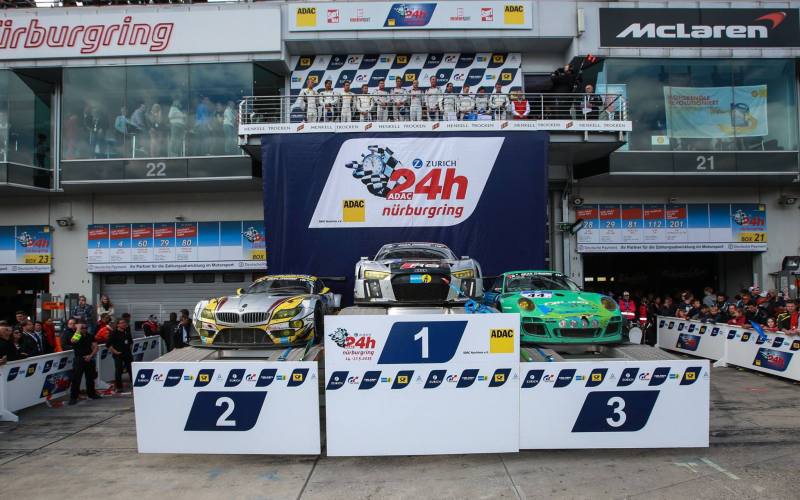
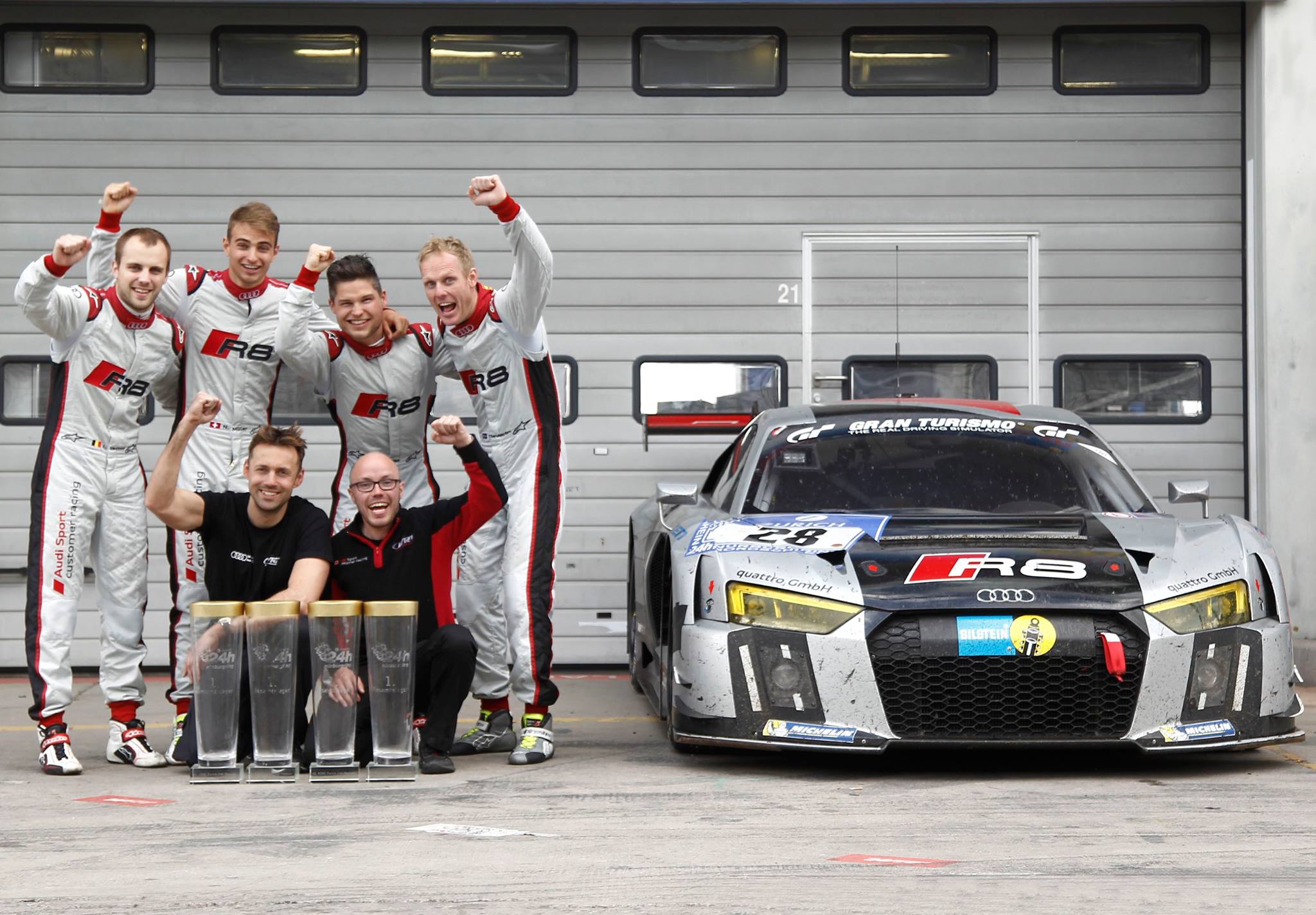
Congratulations to Belgian Team WRT (Drivers:Christopher Mies, Nico Müller, Edward Sandström and Laurens Vanthoor) for winning the 2015 Nurburgring 24 hour race. This is also the inaugural debut and first win of the new 2015+ spec Audi R8 LMS at the Nurburgring 24 hour event. This is the second consecutive time in 2 years that Audi Sport have won the 24 hour race at Nurburgring with the Audi R8 LMS platform. Audi Sport Team WRT completed an overall of 156 laps to win the tough 24 hour race which featured very close racing. With only a 40 second gap to second place, this year featured the closest finish ever for the 24 hour event.

2015 NBR 24 hour winner - Audi R8 LMS by Team WRT. Photo Credit : Audi Sport

2015 NBR 24 hour winner – Audi R8 LMS by Team WRT. Photo Credit : Audi Sport

At the end of the 2015 24 hour race, 3 out of the top 5 and 6 out of the top 10 overall were equipped with Brembo Racing brakes. The winning Belgian Team WRT Audi R8 LMS was also equipped with Brembo Racing RB340 endurance racing pads. Audi Sport equips Brembo Racing brake systems and Brembo RB340 pads on all 2015+ spec Audi R8 LMS cars.

2015 24 Hours of Nurburgring – Top 10 Results

  • First: #28 – Audi Sport Team WRT, Audi R8 LMS – Brembo Racing equipped
  • Second: #25 BMW Sports Trophy Team Marc VDS, BMW Z4 GT3
  • Third: #44 – Falken Motorsports, Porsche 997 GT3-R – Brembo Racing equipped
  • Fourth: #26 BMW Sports Trophy Team Marc VDS BMW Z4 GT3
  • Fifth: #5 Black Falcon, Mercedes-Benz SLS AMG GT3 – Brembo Racing equipped
  • Sixth: #17 Walkenhorst Motorsport, BMW Z4 GT3
  • Seventh: #29 – Audi Sport Team WRT, Audi R8 LMS – Brembo Racing equipped
  • Eighth: #11 – Bentley Team HTP, Bentley Continental GT3 – Brembo Racing equipped
  • Ninth: #35 – Nissan GT Academy Team RJN, Nissan R35 GT3
  • Tenth: #33 – Team Premio, Mercedes-Benz SLS AMG GT3 – Brembo Racing equipped
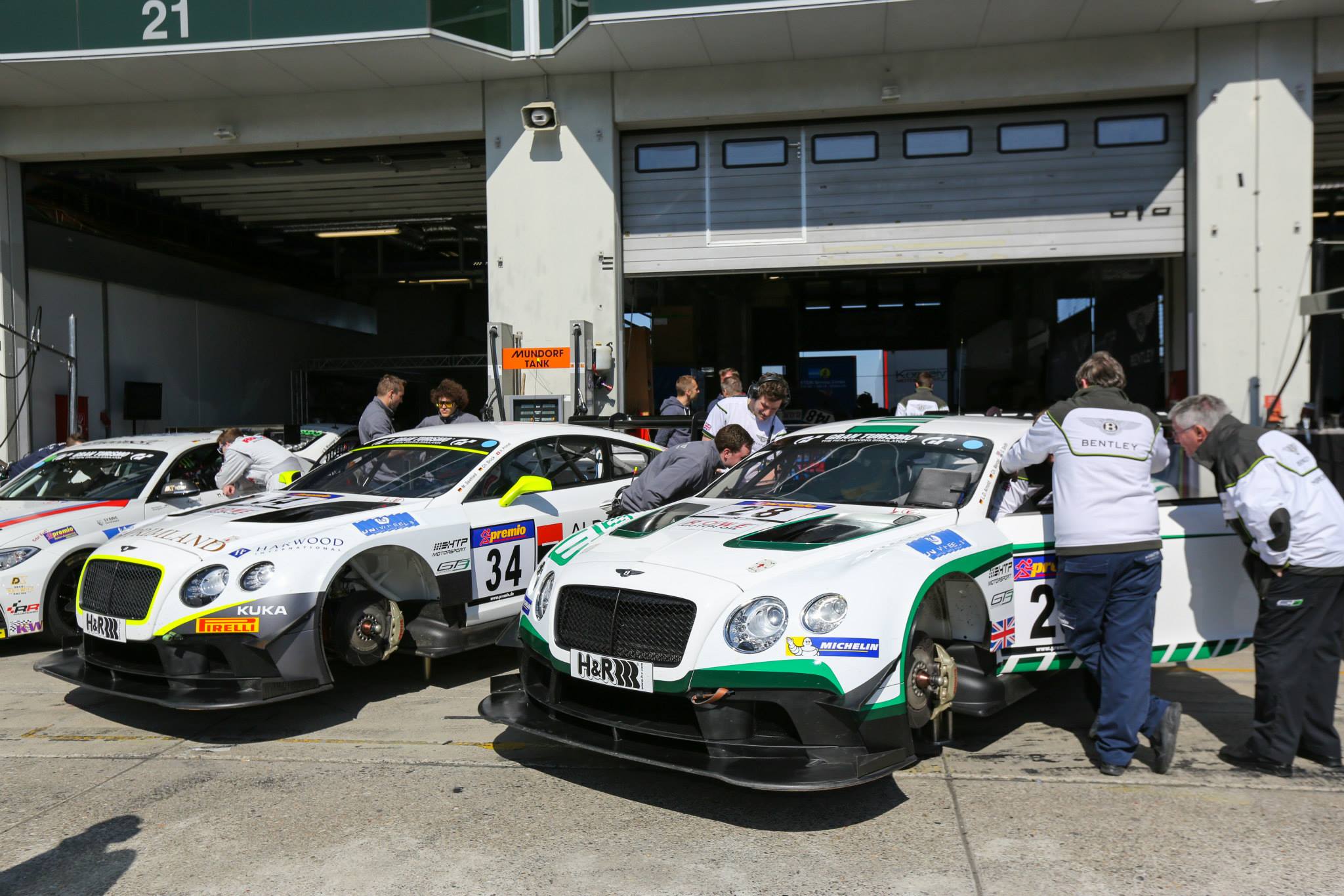
Bentley Continental GT3 running for the first time at Nurburgring 24. Photo Credit: Team HTP Motorsport.

Bentley Continental GT3 running for the first time at Nurburgring 24. Photo Credit: Team HTP Motorsport.

Brembo Racing RB340

The Brembo RB340 material offers excellent wear resistance, high initial bite, stable friction levels (the performance does not degrade as much at elevated temperatures) and good modulation in a wide range of conditions. Brembo’s RB340 material is unique in construction as the optimal performance of the material is dictated by the energy of the brake system, not specifically the braking surface running temperature. This also means the material performance can be stable in a wide temperature range. The combination of wear resistance and a high initial attack means the driver does not need to use as much pedal effort to achieve the optimum stopping power and potentially fewer brake pad / disc changes in an endurance race.

Photo Credit: Aston Martin Racing

Photo Credit: Aston Martin Racing

2015 24 Hours of Nurburgring – Overview

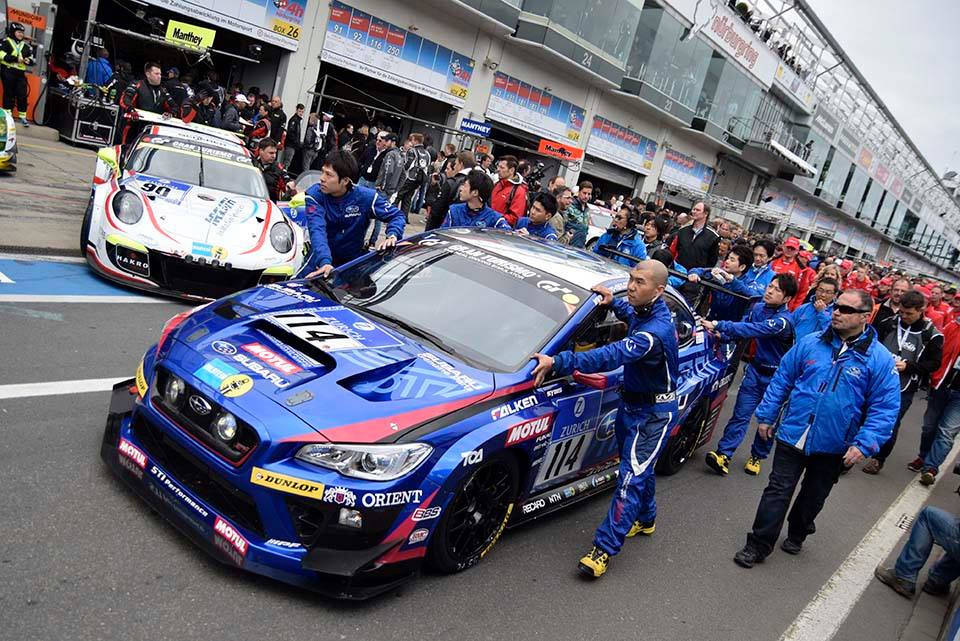
The 24 hour endurance event which has been running since 1970 and is one of the most important races that car manufacturers running FIA GT3 based cars (which is increasingly becoming the global platform for GT racing) focus on. Many teams, car manufacturers (Examples: Audi, AMG, Porsche, Subaru, Hyundai) and technical suppliers even have facilities near the Nurburgring for extensive testing of professional racing and production based cars. The 2015 24 hour endurance event had over 150 entries which included factory supported FIA GT3 spec cars as well as privateer teams running cars such as the BMW E46 M3, Subaru Impreza WRX STi, Opel Astras and Volkswagen GTi which all race on the same circuit in separate classes.

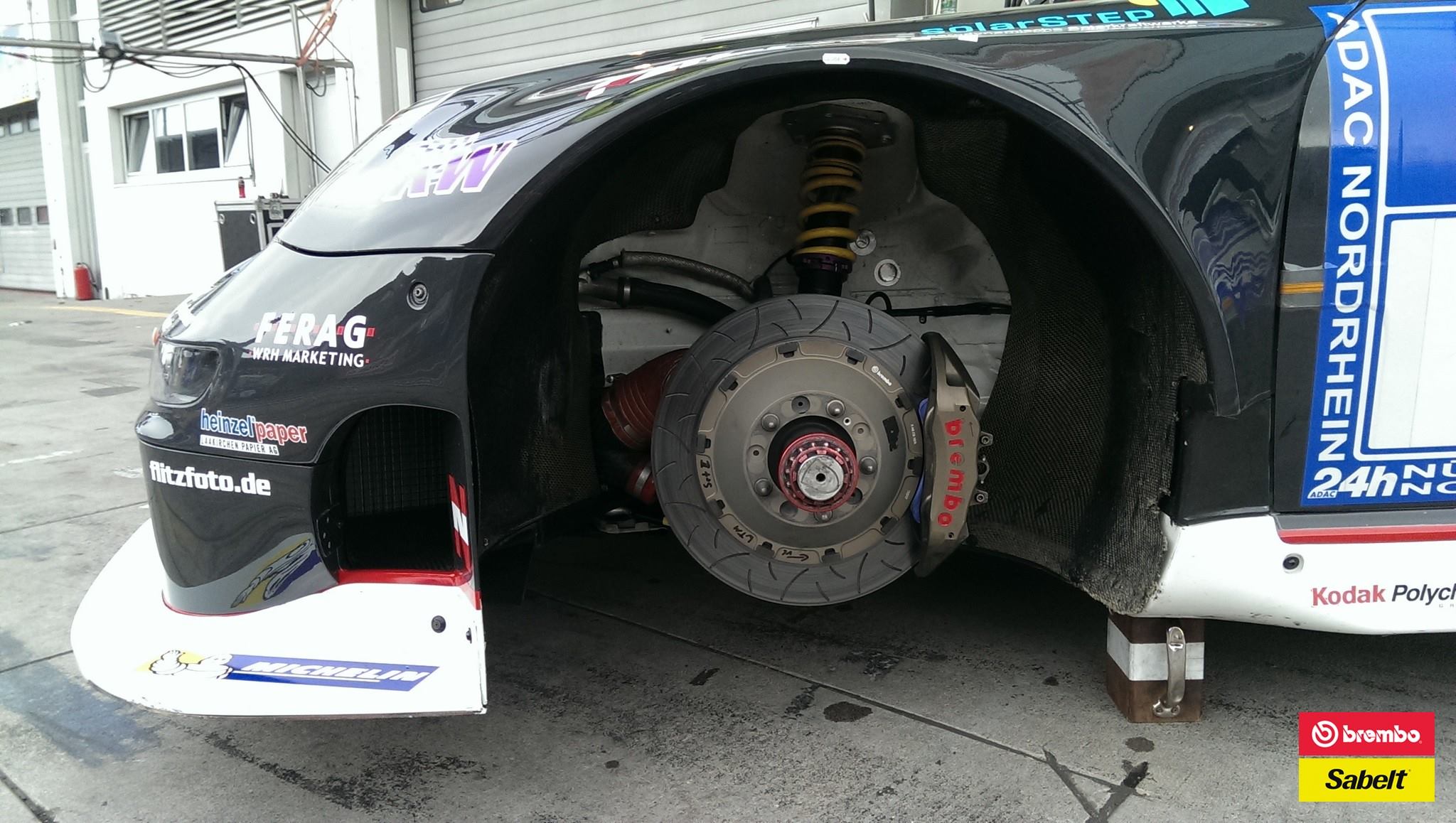
2015 Nurburgring 24 - SP3T Class winning Subaru WRX STI NBR equipped with Brembo brakes. Photo Credit: Subaru Global

2015 Nurburgring 24 – SP3T Class winning Subaru WRX STI NBR equipped with Brembo brakes. Photo Credit: Subaru Global

The Nurburgring circuit is very difficult, fast, unforgiving and over 15 miles in length to complete one lap. 2015 featured several mandatory “slower speed zones” for driver and spectator safety as the modern GT3 specification cars are just as fast, if not faster than previous years in which they can easily hit 300 km/h plus on the straightaways. The reduced speed sections meant that teams could potentially add more down force and focus on overall grip versus overall top speed. With more down force comes the ability for higher braking performance. The 24 hour race always features changing grip levels on the track, slow & fast blind corners, rain, black ice and very fast straightaways which end in long as well as heavy brake zones. With the addition of “slow zones”, sudden traffic build up was a major factor as well especially at night-time. Brakes must offer a high level of performance, control, be consistent and have low wear (fewer pad changes in an endurance race means less time lost in the pits).

Falken Motorsport GT3-R with Brembo Type 3 discs. Photo Credit : Falken Motorsport

Falken Motorsport GT3-R with Brembo Type 3 discs. Photo Credit : Falken Motorsport

5th place finishing Black Falcon SLS AMG GT3. Photo Credit : Black Falcon Racing Team

5th place finishing Black Falcon SLS AMG GT3. Photo Credit : Black Falcon Racing Team

The Nurburgring circuit and the 24 hour race in Germany is regarded as one of the most demanding events in the world on teams, equipment, and drivers. It is the event where the latest and most cutting edge professional GT sports car technology is showcased.

Brembo (General News) Brembo Racing

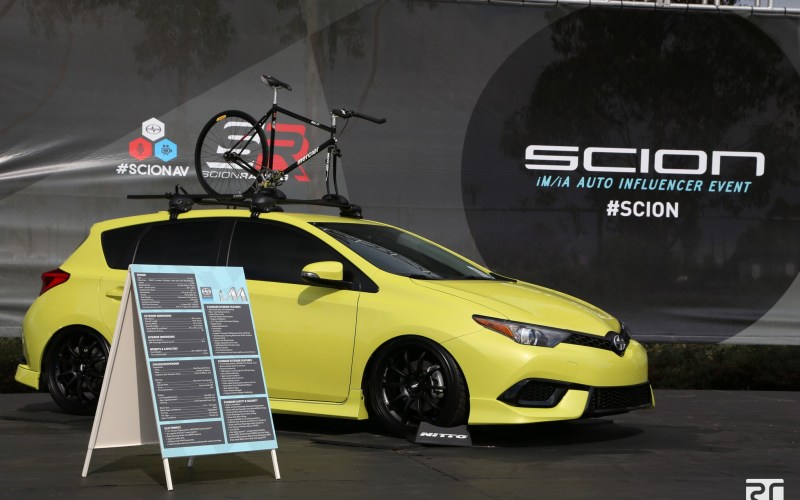
Scion iM/iA Auto Influencer Event

Race Technologies, the Brembo Official Partner was invited to the launch of the Scion iA and iM event. This special industry-only event paid homage to car enthusiasts and their love to car enthusiasts and their love of car culture, showcasing customized Scions, project cars, exotics and classics, along side like-minded individuals who live and breathe cars.

Took place at the Toyota Headquarters in Torrance, CA.

Even Partners: TRD, GReddy, Brembo, FiveAxis, Tein, LTMW, Bulletproof, Hankook, Rays, Sparco, KW Suspension, Mackin, Team Associated, and more

Events

Brembo Brake Discs: Face Types

HOW DISC FACE TYPES (SLOT / GROOVE TYPES) AFFECT BRAKE PERFORMANCE:

Brake discs are one of the major brake tuning options which a professional race team has at their disposal at any typical race weekend. There are many subtle changes that can be made to a brake disc casting or configuration which can drastically influence braking characteristics. A brake disc’s face type (slot / groove pattern) is one of those changes, and can influence many braking characteristics.

Some of them are:

  • Initial response (bite)
  • Control and modulation
  • Release
  • Pad wear
  • Disc wear
Brembo Racing Type III Discs installed on GMG Twin Turbo Audi R8

Brembo Racing Type III Discs installed on GMG Twin Turbo Audi R8

There are also many variables which are considered when engineering a brake disc face type. Changing some of these variables can drastically influence the overall performance of the brake disc. Some (of the many) variables which are taken into consideration for brake disc slot design are:

  • Slot depth
  • Slot angle
  • Length of slot
  • Number of slots
Audi R8 LMS with Brembo 370 mm Type 1 racing discs in the front. Photo: James Boone

Audi R8 LMS with Brembo 370 mm Type 1 racing discs in the front. Photo: James Boone

Brembo and Brembo Racing primarily offer 4 different brake disc face patterns based on the application, intended use, driver preference, and other technical requirements of the application or chassis.

Drilled: drilled brake discs are suitable for a wide range of applications, operating temperatures and driving environments (especially wet weather).

  • Benefit: offers the highest initial response of all the available disc face types while continuously refreshing the braking surface and being also typically a bit lighter.
  • Drawback: Drilled discs are generally more prone to heat checking and thermal cracking if used consistently at extremely high temperatures. This however, really depends on the track, driver, and chassis setup.
Brembo drilled disc assembly

Brembo drilled disc assembly

Type I: Brembo “8 straight – slot” face type with an emphasis on stable brake feel and improve resilience against thermal cracking.

  • Benefit: stable braking feel at all temperatures, low disc wear, and continuously refreshing the braking surface for optimum performance.
  • Drawback: The Type 1 standard disc face has the lowest “initial response” or “bite” compared to Brembo Drilled, Type III or Type V discs.
Brembo Type 1

Brembo Type 1 “8 slot” disc assembly

Type III (aggressive face type): motorsport developed face type with an emphasis on high initial response while maintaining a smooth pedal release.

  • Benefit: highest overall braking confidence, control, and allows driver to spend less time on the brake pedal. When chasing the fastest lap time, less time on the brake pedal typically leads to a quicker lap time.
  • Drawback: Any disc with an aggressive face type like the Type III will have a higher chance to mechanically abrade the pad and disc surface leading to quicker or uneven pad wear. However, this really depends on variables such as car setup or track layout.
Brembo Type III Disc assembly

Brembo Type III Disc assembly

Type V (Endurance face type): motorsport developed face type with marginally less initial response compared to the type III face type. The Brembo Racing type V face type was also designed to have lower pad and disc wear for certain long distance endurance races (mostly 10, 12 and 24 hour races).

  • Benefit: braking modulation and control similar to Type III, while offering lower overall pad and disc wear on the track.
  • Drawback: While the most well balanced of all Brembo face types, Type V discs generally do not have as high of an initial response compared to the Type III.
Brembo Type V Disc assembly

Brembo Type V Disc assembly

Brembo (General News) Brembo Performance Brembo Racing

STOLEN Scion FR-S (please share and help find the car/parts)

UPDATE: the car was recovered whole.
The car was most likely taken around for a joy ride but ditched without any damage.

***** STOLEN (Please Help)*****

This is why we can’t have nice things.

May 8th, “I would like to take this opportunity to express a sincere “THANK YOU” to everyone who shared this post and helped me on getting the car back. Million thanks to my colleague for staying overnight searching these parts on Craigslist and all 86 related forums, Race Technologies for making this post and countless support. All my friends from 86 cup Garrett Tokuno Ted Park Julio Gorgé Mike Kang Marlon R Tecson Derek Dicker Van Nguyen for sharing this post to the community. My homies Gary Yeung driving all day/night in the Bay Area looking for the car. Like I said, there is a cash reward to those who can find me the car. Whether car is in one piece or just a barebone chassis, I still want it back in my garage! – Simon”
PLEASE HELP AND SHARE THIS POST. The car community is extremely strong, so we should be able to recover Simon’s (the owners) car/parts. Also there’s a cash reward with no questions asked.

Stolen in the Bay Area at around 4 a.m. on Monday (5/4/15) in Burlingame, CA (Simon was in the Bay Area participating in the 86 Cup).

Here’s the parts list:

  1. Greddy 2.1 Stroker
  2. Kraftwerk Supercharger Kit
  3. Koyo Radiator
  4. JRZ RS Pro Coilover
  5. Brembo Club Race Front BBK
  6. RE10 Front Brake Pad
  7. TS20 Rear Brake Pad
  8. Voltex Type 2 Center Mount Rear Wing
  9. Volk Racing TE37RT 17×9.5 5×100 +40
  10. Hankook TD 255/40ZR17
  11. MoonFace Roll Center
  12. Cusco Front Tower Bar
  13. Cusco Rear Tower Bar
  14. Tomei Expreme 60R
  15. Tomei Front Pipe
  16. Tomei Over Pipe
  17. Tomei Equal Length Header
  18. O.S Giken Clutch Kit
  19. O.S Giken LSD
  20. 4.556 Final Drive
  21. Cusco Rear Differential Cover
  22. Sabelt Steering Wheel
  23. Sabelt GT140 Seat (Driver)
  24. Bride Zeta III Seat (Passenger)
  25. Works Bell Hub
  26. Works Bell Quick Release
  27. Sabelt 5 Point Harnesses
  28. Cleib Front Lip Spoiler
  29. Cleib Side Panels
  30. Cleib Rear Diffuser
  31. Whiteline Differential Bushings
  32. Whiteline Subframe Bushings
  33. Whiteline Rear Trailing Arm Bushings
  34. Tom’s Rear Taillights

If you have information regarding this car, please contact the owner: simon@renn-spec.com or text/call (626) 215-3231. Thank you for your support/help.

Brembo (General News) Brembo Performance

Brembo Carbon Materials (CCM, CCM-R, and Racing Carbon)

Brembo Carbon Materials (CCM, CCM-R, and racing carbon)


Brembo Offers 3 Types of Carbon Based Discs:

  1. Carbon Ceramic (CCM): street use
  2. Carbon Ceramic (CCM-R): street and track use
  3. Carbon-Carbon: race use

Original Equipment Carbon Ceramic Material (CCM):

CCM discs supplied for the OEM are designed to offer significant weight savings over typical cast iron OEM discs while offering outstanding performance and very long life under typical street use. However, OEM CCM discs have limitations for serious performance driving and dedicated track use.

17637_873921426005678_2766597177505507875_n

Carbon ceramic offers significant weight savings over typical cast iron OEM discs

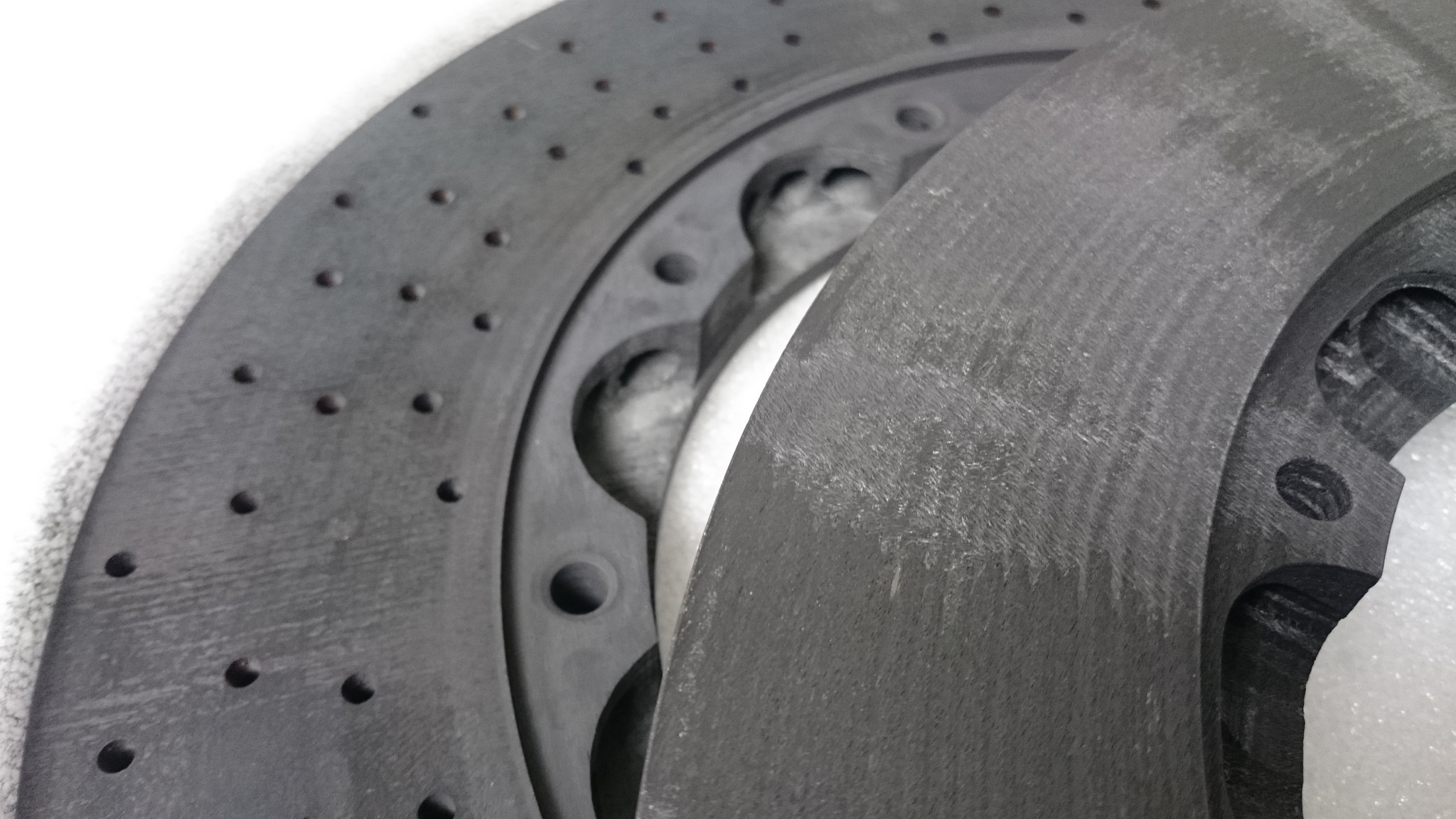
OEM CCM discs do not wear in the same way as cast iron discs. The life on CCM discs is determined by the loss of disc mass as the material oxidizes. This cannot be verified by simply measuring the overall disc thickness like traditional iron discs. Each disc assembly is weighed after assembly and then the minimum allowable weight is permanently etched into the bell. In order to check the weight after use, a cleaning procedure must be performed before checking the weight.

An exhaustive on-road and on-track test program is needed during vehicle development in order to manage airflow to the discs in order to provide enough cooling to achieve satisfactory component life. Oxidation increases rapidly with temperature and it is for this reason that extended high temperature use such as experienced on the race track dramatically reduces the discs life.

OE carbon ceramic (CCM)

OEM carbon ceramic (CCM)

OEM CCM discs are designed to be used with very specific brake pad materials. While there are other pad materials supplied on the market by various pad manufacturers claiming to be “CCM friendly”, there is currently no established validation process for such materials. Pad materials developed for cast iron brake discs will have considerably different results when used on CCM if the various factors are not considered. Pads used with CCM discs also have much greater surface area than would be present in a similar performing cast-iron system which somewhat offsets the weight savings of the disc.

  • Production Process Time: Relatively quick production time (for a carbon-based material), approximately 4 weeks (1 month).

Brembo Racing IndyCar Carbon racing discs & pads

Brembo Racing IndyCar carbon racing discs & pads

Brembo Racing Carbon-Carbon:

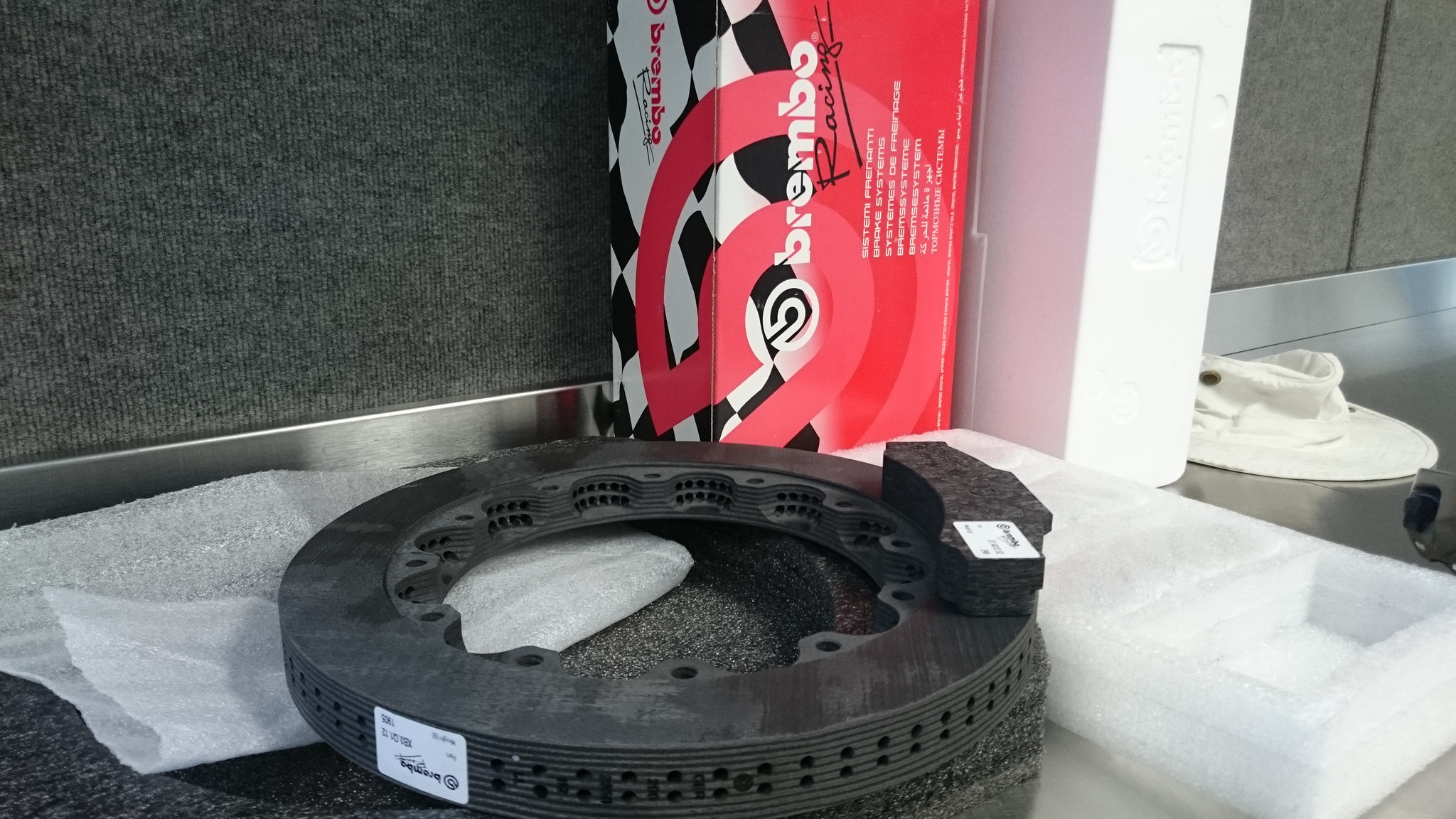
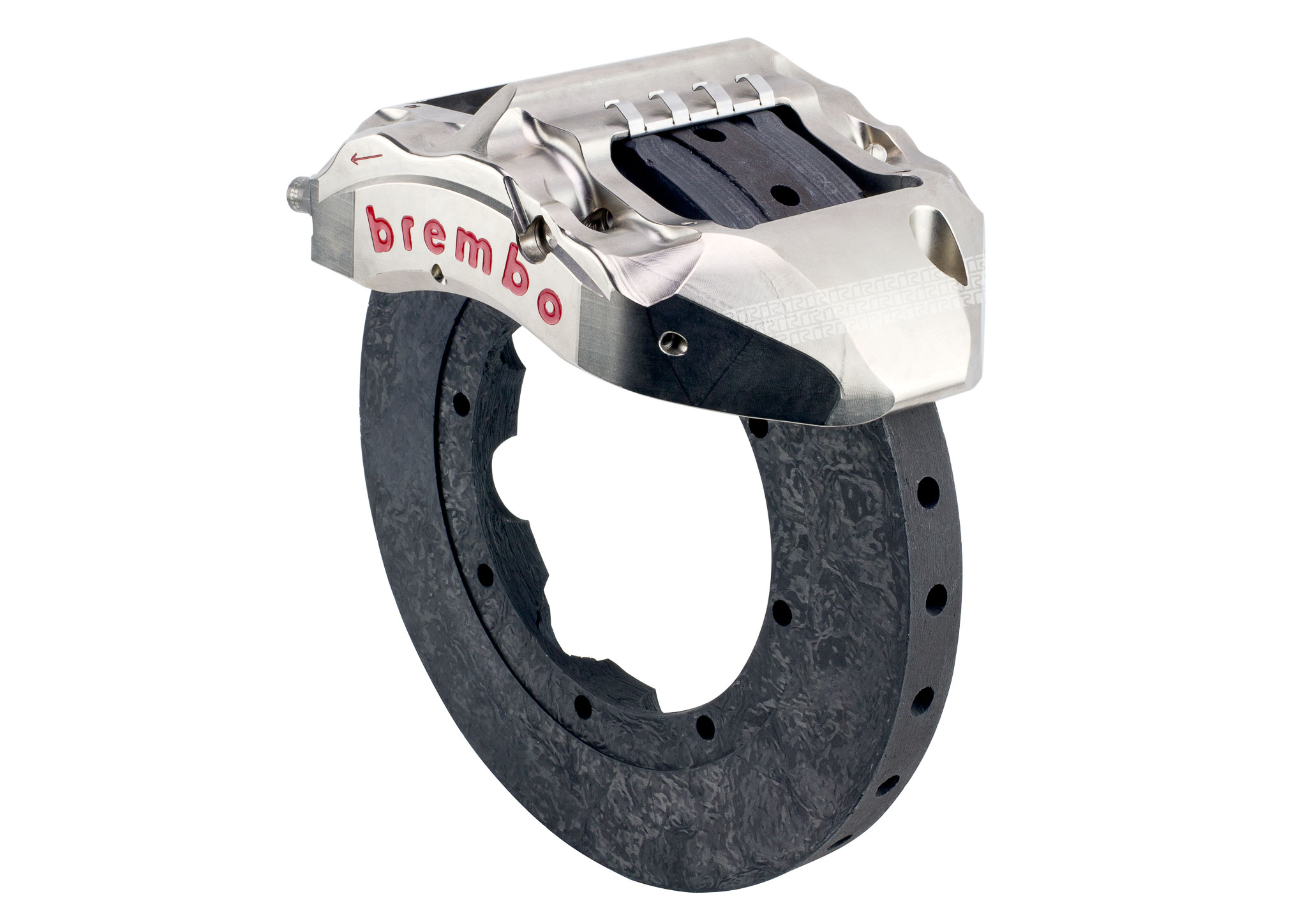
Brembo carbon-carbon materials are used in the top levels of professional motorsports in such racing categories as open wheel (i.e. Formula 1 and IndyCar) and sportscar racing (i.e. LeMans and LMP1) amongst others. The latest motorsport carbon-carbon discs offer stable performance over a wide temperature range, are extremely lightweight, and are highly wear resistant.

Brembo F1 carbon-carbon disc

Brembo F1 carbon-carbon disc

While many companies market high performance and racing carbon materials, there are only a few manufacturers who sell carbon-carbon brake materials to the top levels of professional motorsports. These are: Brembo, Carbone Industrie, and Hitco (a subsidiary of the Brembo SGL Group). Brembo supplied over 60% of the Formula 1 field in 2014 and is the sole supplier for IndyCar, Along with supplying brake systems to both factory run Porsche and Audi LMP1 efforts in the FIA WEC (World Endurance Championship) for 2015. It is quite normal for an LMP1 car racing at the 24 hours of LeMans to finish the endurance race without any disc or pad change.

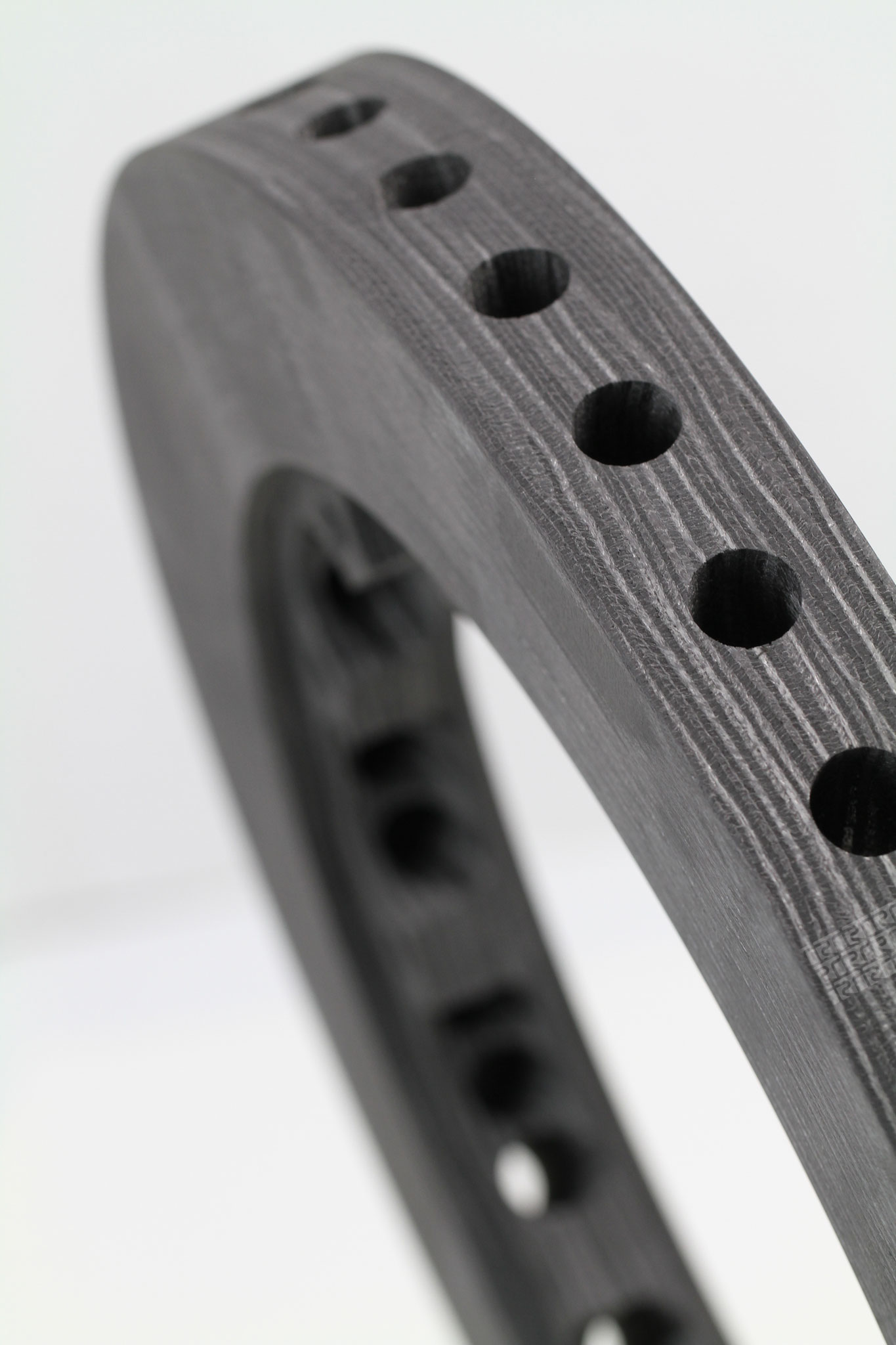
Side profile of a carbon-carbon disc.

Side profile of a carbon-carbon disc.

Racing carbon-carbon systems differ from other brake systems in that they utilize a pad that is also made of carbon-carbon material very similar to the disc material. There are specific carbon-carbon formulations for the disc and pads that can be chosen to suit the system to the needs of the racing series, car, track, or driver.

Wear occurs in a carbon-carbon system both through material thickness reduction, as well as by oxidation. During a braking event, the temperatures reached in a carbon-carbon system can be well in excess of those seen in a racing cast-iron system, but the airflow management must be such that the temperatures are brought down significantly to avoid excessive oxidation. Racing carbon-carbon systems do not work well at low temperatures, and are for motorsports use only.

  • Production Process Time: Approximately 28 weeks (7 months) for production from start to finish.

Brembo CCM-R discs.

Brembo CCM-R discs.

Brembo CCM-R:

Brembo created the CCM-R material by applying the knowledge gained through developing and supplying carbon-based brake materials for both OEM road use and racing applications. Brembo CCM-R discs are sized and cross-drilled similar to the OEM CCM material discs, however, the base material, production process and construction is more in-line with Brembo carbon-carbon racing discs. CCM-R discs were developed with high-performance and racing use in mind.


Debut of CCM-R for the Nissan GT-R (R35)

Brembo CCM-R material comparisons to CCM:

  • Increased material strength, thermal conductivity, and coefficient of friction
  • Reduced temperatures
  • Significant increase in disc life, especially under track conditions
  • Density similar to CCM, but potential for reduced weight due to ability to reduce disc and pad dimensions
  • Wear extent can be determined by visual inspection

CCM-R discs and pads are delivered pre-bedded with a specific friction material for street and track use which will operate in a wide temperature range. If the customer is using the vehicle for primarily track or race use, a race-only material can be specified.

  • Production Process Time: Approximately 28 weeks (7 months) for production from start to finish.
Porsche 997 GT3R Hybrid Equipped with Brembo Racing brakes - ALMS 6 hour endurance race

Porsche 997 GT3R Hybrid Equipped with Brembo Racing brakes – ALMS 6 hour endurance race.

Porsche 997 GT3R Hybrid Equipped with Brembo Racing brakes  - ALMS 6 hour endurance race

Porsche 997 GT3R Hybrid Equipped with Brembo Racing brakes – ALMS 6 hour endurance race


Pre-Bedding:

Pre-bedding is the process of transferring pad material to the disc surface in a controlled environment. It is critical to have a transfer layer of pad material on the CCM-R disc to generate friction. Due to the material strength of CCM-R and the high level of surface hardness, it takes considerable pressure and temperature to transfer pad material onto the disc surface. This is done on a high inertia brake dynamometer using very specific computer controlled programs at the Brembo factory.

Carbon ceramic pads that were used to pre-bed the discs

Carbon ceramic pads that were used to pre-bed the discs

Brembo CCM-R discs pre-bedded and matched to specific friction materials.

Brembo CCM-R discs pre-bedded and matched to specific friction materials.

Representative Component Weights:

  • Brembo 355x32mm, 53mm annulus Cast-Iron 72-vane disc ring: 16.5 lbs
  • Brembo 360x32mm, 64mm annulus CCM-R disc ring: 7.5 lbs
  • Brembo 355x32mm, 53mm annulus Carbon-Carbon disc ring: 5.8 lbs

Typical Pad Weights – For Perspective:

  • Brembo 6-piston 26mm thick Cast-Iron disc race pad: 1.8 lbs
  • Brembo 6-piston 17mm thick CCM-R disc pad: 2.7 lbs
  • Brembo 6-piston 26mm thick Carbon-Carbon race pad: 0.7 lbs
Brembo CCM-R Grain Structure and Brembo Carbon Carbon grain structure

Brembo CCM-R Grain Structure and Brembo Carbon Carbon grain structure

Brembo (General News) Brembo Performance Brembo Racing

Sabelt x Corner 3 Motorsports

Corner 3 Motorsports, a stocking Sabelt authorized dealer in southern California specializing in high performance Japanese platforms supplied the following Sabelt products for Alex Rodriguez’s Time attack FD Rx7:

The Sabelt package:

– Sabelt GT160 Halo full bucket racing seat.
– Sabelt 6 Point 2 to 3 inch “HANS specific” harness.
– Sabelt SW633 330 mm suede steering wheel.

The Sabelt package offered the following advantages to the driver (based on driver comments):

– GT160 seat lowered the driving position so the drivers’ head (when using a helmet) no longer hit the roll bar of the vehicle.
– GT160 seat also improved driving position for better heel and toe downshifts.
– Sabelt 6 point harness fitted flush with the HANS Device and the submarine belt was much more comfortable. This was due to the 2 belt “split design” of the submarine belt.
– Sabelt steering wheel was thicker and more comfortable to use compared to the old steering wheel.

Corner 3 Motorsports focuses on three core philosophies: complete knowledge in the services they provide, specializing is only a few select Japanese platforms, and working with the most premium brands that best represent them. Corner 3 chooses Sabelt because Sabelt supplies safety components to professional motorsports, has a comprehensive product range to suit their clients needs and is a market leader in safety equipment.

Sabelt was founded in 1972 and part of the Brembo group since 2008, is a technology leader supplying safety equipment to the high performance and professional racing markets.

Contact Information:

Web: http://www.corner3garage.com
Address: 22701 Granite Way, Laguna Hills, CA 92653
Phone: 1-(949) 380-0801

Photos Provided by: Corner 3 Motorsports

11111207_955194567848384_920675176330577715_n

Alex’s time attack FD3S equipped with sabelt GT160 seats

Sabelt Steering Wheel

Sabelt Steering Wheel

Brembo (General News) Sabelt

Can I use calipers off of “XXX” and place it on my “XXX”?

Originally posted on Modified Magazine

Mark Valskis from Brembo North America helps explain what goes into a properly designed big brake system. Upgrading the brakes on Honda Civics to Type-R calipers and rotors or bolting up the bigger 300ZX brakes to S13s and S14s are classic examples of upgrade paths that have proven to be both affordable and effective for grassroots enthusiasts. But more recently I’ve noticed a trend where some hard parking import enthusiasts are bolting huge multi-piston calipers and rotors off of European exotics like Porsches and Ferraris to their Subarus, Mitsubishis, Hondas and Nissans. This may look cool in the coffee shop parking lot, but as I learned when upgrading to the 1-inch Type-R master cylinder from the original 13/16-inch CX model master cylinder on my EG race car (which made a huge difference in brake pedal feel and firmness), there’s a lot more to properly upsizing your braking system than just adding larger-diameter rotors and increasing the number of piston in your calipers. According to Mark Valskis, engineering manager at Brembo North America, The first thing to consider in regards to the brake system is safety. There is a very large misconception that any caliper can be used on any vehicle, as long as it can be made to physically bolt up in some manner. However, there are vast differences in braking systems between vehicles, and often in ways that would not be predicted. For example, a Subaru WRX has approximately 30 percent more brake piston area than a Porsche 911. Taking a caliper from that Porsche application and applying it to a WRX (all other things being equal) would result in a 30 percent reduction in braking torque and a significant (and very unsafe) shift of brake balance to the rear of the vehicle. Understanding the importance of rotor thickness, not just diameter, and how this can impact performance and safety is also a key element to factor in when doing any sort of custom retrofitting of brake parts not designed for your car. A fundamental consideration is the brake disc thickness, Mark says. In a great many cases, we see calipers being used on discs that are thinner than what they have been designed for. In these cases, once the pads and the disc have worn, the first thing that can happen is the brake pads move past the abutment surfaces on the caliper, resulting in damage or brake failure. It is also possible that the pistons move completely past the seals in the caliper, resulting in complete and catastrophic brake failure. Just like the rotors, the calipers are also designed for specific operating conditions, so bolting them up to an entirely different chassis can also be problematic, if not downright dangerous. The caliper bodies themselves are built to withstand the structural requirements of their intended application, Mark says. We have seen instances where calipers are being used far outside the bounds of their design loads. The ABS system is also designed to function optimally only within the parameters of the original braking system.

modp_1105_2_o+breaking_bbk+porsche_caliper

Type-R brakes on base-model Civics and Integras is commonplace, but Porsche 6-pot calipers and 14-inch rotors on a Subaru? Is this a case of sacrificing performance for style?

By using components that are well outside these bounds, especially as it relates to fluid volume which is impacted by caliper piston area, caliper stiffness and so on the ABS system performance suffers. Mark also made the excellent point that custom retrofits, like we’re starting to see more of, also involve producing a caliper bracket adapter, a component that needs to be designed, analyzed and tested to prove its integrity for the system’s lifetime. Mark elaborates, Even if the components chosen to adapt are appropriate, without this very important detail being properly designed, the system could also be extremely unsafe and experience a catastrophic failure. The primary benefit of upgrading to bigger brakes is, of course, greater fade resistance and improved modulation, rather than one-stop braking distance. As we experienced firsthand with Project G35, where the undersized (non-Brembo) OEM brakes were quickly overwhelmed by the heat buildup produced by track testing, only when we upgraded to significantly larger brakes (in this case AP Racing front and rear BBKs) did we see consistent braking performance lap after lap. The BBKs provided the ability to efficiently convert, store and dissipate the kinetic energy (in the form of heat) being produced during repeated and heavy deceleration. As to the question, How big is too big? when it comes to upgrading a braking system for high-performance use, Mark from Brembo responded, While mass in the brake disc is generally beneficial to the performance of the braking system, clearly it is not to the other performance parameters of the vehicle, such as acceleration, ride and handling due to the effects of increased unsprung mass. The brake disc mass must therefore be properly balanced with other performance considerations. In many cases, depending on the vehicle in question, it’s possible to reduce the system’s overall weight while increasing the thermal capacity of the brake disc. This is possible due to multi-piece brake discs and high-performance, fixed-mount aluminum calipers in place of factory one-piece discs and cast-iron sliding calipers.

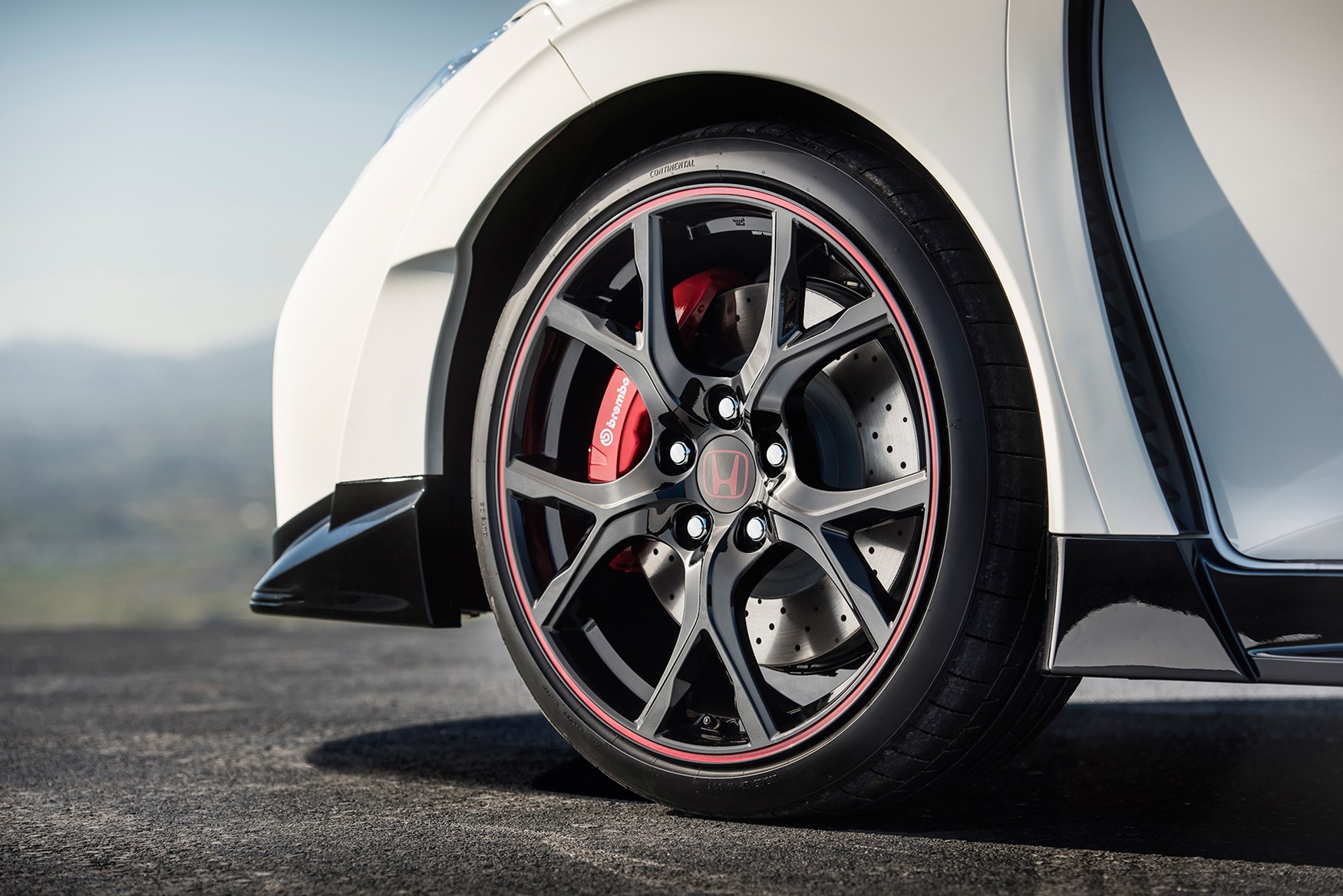
2015 Honda Civic Type-R equipped with a Brembo brake system as Original Equipment (OE).

2015 Honda Civic Type-R equipped with a Brembo brake system as Original Equipment (OE).

Mark then expanded on the topic of brake system sizing by adding, First, we should dispel the myth that more equals better as it relates to components of the brake system, calipers in particular. Simply increasing the number of pistons in a caliper does not make for a superior caliper. The number of pistons in a caliper is a function of optimization for a particular pad shape and piston area, and for the most part, has little direct bearing on the performance of the braking system. Likewise, increasing the piston area is not the mark of a superior brake system. We often see ads or statements expounding upon X percent’ increase in piston area or braking power. The fact is that in almost every circumstance, this is to be specifically avoided. Given that Brembo is the global leader in braking system design, a fact proven by its dominance at the highest levels of motorsport, as well as being the factory choice on many of today’s highest performing road cars, we asked Mark for a little insight into how the company goes about designing its BBKs.

IMG_6461

Brembo’s GT big brake kits are second to none, thanks to the company’s extensive experience

The design of a Brembo GT braking system first begins by an analysis of the original equipment braking system and the pertinent vehicle parameters. This includes the dimensions of all of the original braking system components, including piston area, pad area, disc diameter, thickness, annulus width and air gap. The most pertinent vehicle parameters are the gross weight, weight distribution, center of gravity, wheelbase, top speed and vehicle usage, as well as tire size(s). Calculations are then performed in order to determine the best disc size for the application. Brembo has internal standards for this, based on our experience as an OEM supplier, the performance aftermarket and top-level racing. Due to our unique position in this respect, we have performed tens of thousands of road, track and dyno tests on vehicles and have used this data to establish a threshold for the disc thermal capacity. The caliper piston area is selected in order to closely maintain the original braking torque and fluid volumes. Calculations and dynamic simulations are performed to verify optimum brake balance through the full range of deceleration rates and to ensure safety, performance and the integrity of the ABS system. Further calculations are made for the brake pad surface area and volume. Mark then went on to add that, Each of Brembo’s calipers undergo complete functional and structural testing, as well as environmental testing (salt spray corrosion, etc.) to prove its strength and fatigue lifetime. These tests have been performed at values exceeding that of any application that it is to be employed in. Each time a new application is created, the loads are compared to the qualification values to verify that the caliper meets the structural requirements. If an application should happen to exceed the tested parameters, a full complement of structural and fatigue testing is performed at new higher values. Discs have likewise undergone full dyno testing for thermal shock, thermal fatigue, high deceleration resistance, friction coefficient, wear, etc. The disc bells and caliper brackets are designed to adapt the Brembo disc and caliper to the vehicle. Using the results from the braking system calculations as inputs, these components are analyzed using finite element analysis to evaluate the stress levels, and are physically tested to verify fatigue life at maximum applied torque. There is, of course, a lot of very interesting science and engineering hidden beneath the surface of a high-quality BBK, things like material choices and design considerations that maximize caliper stiffness. Look for a future discussion on this very subject, if we’re fortunate enough to tap into the bottomless pool of brake system knowledge housed by Mark and his team of engineers at Brembo.


Brembo Brakes: Stopping Everything from Ferrari to F1! – The Downshift Ep. 72
On this episode of The Downshift, we head to Bergamo Italy to visit Brembo, the world’s largest brake manufacturer. Brembo was founded in 1961 and has become known for their technical innovation and reliability. Brembo brakes can be found on the worlds fastest road cars, as well as in the worlds most renown racing series from Nascar to F1.

Brembo (General News) Brembo Performance